


Russia's invasion and annexation of Crimea has overtly challenged the familiar contours of the post-Cold War world. The inadequacies of the Obama doctrine and lack of strategic thought have brought Europe to the most dangerous point since the end of the Cold War. Critics of American power have found in Barack Obama the leader they have clamoured for since President Carter — and the results are calamitous.
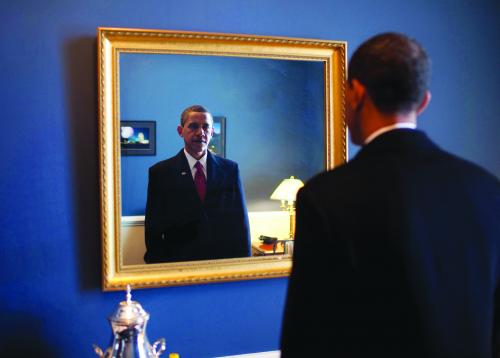
Turning inward? Obama has shaped his strategy around the world as he wishes it to be
At the time of writing, shortly after the Russia's overwhelming victory in the Crimean referendum, Obama is still not acting strategically. Instead his response has focused on short-term economic punishment of the Russians and the joyless task of trying to agree sanctions with both his divided European counterparts and Congress. His limited military response is even less coherent and appears to be leading to escalation with Russia, despite being too small to have any material effect on the situation. Obama met Ukrainian prime minister Arseniy Yatsenyuk, four days before the referendum in Crimea, in which voters had no real choice but to join Russia. Although Ukraine announced that 80,000 Russian troops were massed on the border, Obama's response has been extremely low key. His natural instinct has been a reversion to "leading from behind", evidenced by the length of time it has taken for a coordinated response to emerge from the G7, his astonishing disappearance for a weekend break to Florida and his highly publicised appearance in an inappropriate, satirical interview. Obama has avoided sanctions with real financial bite, both to give diplomacy a chance and to avoid unintended blowback to the US economy. The effect is that he has yet to send a powerful message to Russia about the potential consequences of reshaping Europe's borders. If this is not the moment for an American-led reaffirmation of European security, it is hard to imagine what would be.
Even as the West agrees a low level sanctions regime, President Putin has annexed Crimea with the agreement of its leaders and the Duma. As in the case of Iran, it is not clear what these extremely narrowly focused sanctions are meant to achieve: to ward off escalation of the conflict, result in Russian regime change or secure a return of the Crimea? Of these, only the avoidance of escalation seems likely. The sanctions certainly won't bring security or stability to Europe, they are politically symbolic rather than targeting Russia's economically crucial energy sector. Sanctions with bite would hurt the still fragile US and European economies. The weakness of the sanctions further highlights the deep divisions between America and the EU and between the EU member states themselves. They have been unable to agree on the targets of the sanctions and they missed the vast capital outflows of Russian assets that occurred before the referendum. Obama has let America's relationship with Germany reach a new low, particularly in the key area of security. It also remains far from clear what outcome Obama or the EU would like to see, certainly a return to the previous status quo is not realistic. As a result the sanctions are purely punitive.
The unsuitability of the EU to the type of task at hand is clear, it is not able to agree the communality of strategic purpose that Nato maintained. As EU officials now admit, the drafting of the association agreement with Ukraine, which was the proximate trigger for the current crisis, was largely left to technocrats. It illustrates the complete lack of systematic, strategic thought about the fundamental security issues confronting Europe and Nato and the danger of American outsourcing its Nato security commitment to the EU.
Attempts to cast Russia from the international community permits behaviour hitherto unacceptable. Indeed, Russia's response the day before the Crimean Referendum was to escalate the conflict with further military actions in East Ukraine and ominously the Nato website was subject to a serious cyber attack. The only real winner is Beijing, as Obama is forced to take his eye off South East Asia and fully engage with China's other serious competitor, Moscow. This is the instant when the rules of 21st-century diplomacy, look set to be codified. As a result, the failure to publicly pronounce on Nato solidarity is actually more damaging than Putin's actions themselves.
Like this article? Share, save or print using the icons below:


More Features
- Mr Cameron, Show The Country That You Care
- Campaign Diary
- Defying Duopoly: The Rise Of The Insurgents
- Don't Rig The System In Favour Of Coalitions
- Warring Gangsters Who Run The Country
- Political Correctness Is Devouring Itself
- An Archival Treasure Trove—And All Online
- Do we value freedom of speech in Britain?
- Can Europe's Jews Feel Safe Alongside Muslims?
- We Cannot Avoid The Battle Over Blasphemy
- Inside The World Of 'Non-Violent' Islamism
- We Can Fix The Economy But Not Human Nature
- The Keynesian Versus The Monetarist: A Lost Decade
- The Keynesian Versus The Monetarist: Time To Re-Read Keynes
- The New Language Of Political Narcissism
- Two Words You Won't Hear This Election: Foreign Policy
- The Many Faces Of Holocaust Denial
- Why Is 'Fifty Shades of Grey' the New Normal?
- Obama scuttles. America retreats. Things fall apart
- Putin and the Art of Political Fantasy
Popular Standpoint topics

- The Loss Of Faith Made Music Mute
- The Great Betrayal: How Liberals Appease Islam
- Political Correctness Is Devouring Itself
- The New Language Of Political Narcissism
- Why The World Still Loves Shakespeare
- Don’t Listen to Britain’s Designer Demagogues
- Who's in Charge of BBC News?
- An English parliament: the only way to save the UK
- The Loss Of Faith Made Music Mute
- The Great Betrayal: How Liberals Appease Islam
- Political Correctness Is Devouring Itself
- The New Language Of Political Narcissism
- Why The World Still Loves Shakespeare
- Don’t Listen to Britain’s Designer Demagogues
- Who's in Charge of BBC News?
- An English parliament: the only way to save the UK
- The Loss Of Faith Made Music Mute
- The Great Betrayal: How Liberals Appease Islam
- Why The World Still Loves Shakespeare
- Who Will Lead The Berlin Band?
- Putin and the Art of Political Fantasy
- Political Correctness Is Devouring Itself
- The New Language Of Political Narcissism
- Inside The World Of 'Non-Violent' Islamism
8:04 PM
1:04 PM
2:03 AM