


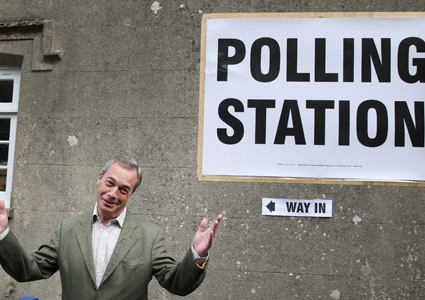
Botched ruling: The Electoral Commission's decision to allow "An Independence From Europe — UK Independence Now" to appear on ballot papers at the top of the list of candidates probably cost Nigel Farage's UKIP two MPs (credit: Getty Images)
Anyone who cares about the hardware of democracy should be concerned that in the European Parliamentary election on May 22, 2014, almost a quarter of a million people voted for an unknown political party called "An Independence from Europe", which did not even exist until March 26, 2014. This new name, with the slogan "UK Independence Now" alongside it, appeared on ballot papers in every region, earning this fledgling political party tens of thousands of votes all over the country — and this happened with the full approval of the Electoral Commission.
It was the brainchild of Mike Nattrass, the former West Midlands UKIP MEP, who had a falling out with the party when he was not selected to run for re-election in 2014. Nattrass registered his new party in May 2012 under the name "4 a Referendum" more than 12 months before he was deselected, so he might have had an inkling of what was coming.
In late 2013, "4 a Referendum Party" morphed into "A Referendum Party" and then an application was made on February 24, 2014, to change the name to "An Independence Party". The following day, the Electoral Commission rejected this name on the grounds that it was "too close to UK Independence Party". The "party description fails on confusion with a registered party" read a note that appears on the paperwork, signed by a Commission official (name redacted). A further application was made on March 21, 2014, to register: "An Independence from Europe". This time the Commission allowed it, giving its approval in less than a week, on March 26. Apparently, the insertion of the words "from Europe" satisfied its previous concerns about "confusion".
What is clear to everyone but the Electoral Commission is that this new party name and slogan were deliberately placed on the ballot paper to confuse voters. It was a blatant example of "passing off" one party for another. The fact that the Commission realised there was potential for confusion if it allowed the name "An Independence Party" makes it all the more troubling that it allowed the subsequent application simply because the words "from Europe" had been added.
Parties are listed on the ballot paper in alphabetical order. Cunningly, Nattrass had registered a name that would appear at the top of the ballot paper and added the slogan "UK Independence Now", knowing that the real UKIP would appear at the bottom. In many polling stations, and most notably on postal ballots, the ballot paper was folded, putting UKIP behind a fold and Nattrass's new name on top of what was a lengthy sheet. It was a direct appeal to the core of UKIP's support and there is no doubt that it confused voters on a large scale.
Like this article? Share, save or print using the icons below:


More Features
- Mr Cameron, Show The Country That You Care
- Campaign Diary
- Defying Duopoly: The Rise Of The Insurgents
- Don't Rig The System In Favour Of Coalitions
- Warring Gangsters Who Run The Country
- Political Correctness Is Devouring Itself
- An Archival Treasure Trove—And All Online
- Do we value freedom of speech in Britain?
- Can Europe's Jews Feel Safe Alongside Muslims?
- We Cannot Avoid The Battle Over Blasphemy
- Inside The World Of 'Non-Violent' Islamism
- We Can Fix The Economy But Not Human Nature
- The Keynesian Versus The Monetarist: A Lost Decade
- The Keynesian Versus The Monetarist: Time To Re-Read Keynes
- The New Language Of Political Narcissism
- Two Words You Won't Hear This Election: Foreign Policy
- The Many Faces Of Holocaust Denial
- Why Is 'Fifty Shades of Grey' the New Normal?
- Obama scuttles. America retreats. Things fall apart
- Putin and the Art of Political Fantasy
Popular Standpoint topics

- The Loss Of Faith Made Music Mute
- The Great Betrayal: How Liberals Appease Islam
- Political Correctness Is Devouring Itself
- The New Language Of Political Narcissism
- Why The World Still Loves Shakespeare
- Don’t Listen to Britain’s Designer Demagogues
- Who's in Charge of BBC News?
- An English parliament: the only way to save the UK
- The Loss Of Faith Made Music Mute
- The Great Betrayal: How Liberals Appease Islam
- Political Correctness Is Devouring Itself
- The New Language Of Political Narcissism
- Why The World Still Loves Shakespeare
- Don’t Listen to Britain’s Designer Demagogues
- Who's in Charge of BBC News?
- An English parliament: the only way to save the UK
- The Loss Of Faith Made Music Mute
- The Great Betrayal: How Liberals Appease Islam
- Why The World Still Loves Shakespeare
- Who Will Lead The Berlin Band?
- Putin and the Art of Political Fantasy
- Political Correctness Is Devouring Itself
- The New Language Of Political Narcissism
- Inside The World Of 'Non-Violent' Islamism
5:12 PM
6:10 PM
5:10 PM