


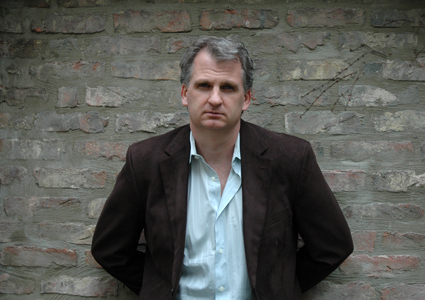
 Timothy Snyder: In “Black Earth” the Yale historian sets out to explain why the Holocaust happened and comes up with problematic answers (photo: Ine Gundersveen)
To state that Timothy Snyder’s heavily trailed book, Black Earth: The Holocaust as History and Warning (Bodley Head, £25) is bad history does not begin to express its shortcomings. It is a muddled hotchpotch of political prejudices masquerading as academic analysis. The volume needs to be understood against the background of the Yale history professor’s activities as a prime agitator in the new Cold War against Vladimir Putin’s Russia and on behalf of an increasingly powerful European Union. It also reflects the anti-Israel stance of his intellectual milieu. Indeed, the justification for paying attention to the book at all is the prominent role in current European politics being played by some of the ideas he and others are advocating.
Black Earth is the sequel to Bloodlands: Europe Between Hitler and Stalin, which was translated into 35 languages between 2010 and 2014. In Bloodlands, Snyder drew attention to the prevalence of mass murders of civilians by Joseph Stalin and Adolf Hitler in Eastern Europe from 1933 to 1945. It was in this territory that most Jewish victims were killed.
In Black Earth, the author now sets out to help us understand why the Holocaust happened, “a subject that is crying out for explanation”, he said in his 2013 Girard lecture at Stanford University.
His thesis is simple and, for those unfamiliar with recent German-language publications, surprising. Summarily rejecting what he has called the “standard” reasons, he argues that the Holocaust had two causes: Hitler’s “ecological panic” (the fear that German housewives would not have enough food to feed their families in comfort) and the breakdown of sovereign states in Eastern Europe. He asserts that “[t]he German murder of five and a half million Jews, more than three million Soviet prisoners of war, and about a million civilians in so-called anti-partisan operations all took place in stateless zones”.
This interpretation leads Snyder to issue his main “warning” for the future. We are in an age of global warming. The resulting desertification of some areas and the flooding of others lead to a risk of failed states. The result may well be another catastrophic struggle to control bread-producing lands such as the fertile expanses of Ukraine. It is in this context that Snyder has been engaged in such active pro-Ukrainian advocacy while it has been under attack from Russia.
Apart from Snyder’s disputable views about present-day European politics, something considered later in this essay, his historical approach is open to criticism on a series of grounds.
Like this article? Share, save or print using the icons below:


More Features
- Euphoric Labour won’t win power led by a pied piper
- Don’t be ‘difficult’ — try ‘formidable’, Mrs May
- Enough is enough of terror — but also of our self-doubt
- Iraq’s Christians pray for help that never comes
- The Atlantic alliance may be broken beyond repair
- Catholic tastes: both English and European
- Brexit as myth: Exodus, Reckoning, or Sacrifice?
- A Decent Woman Betrayed By Her Gruesome Twosome
- Can Macron Save France — Or Is He Its Undertaker?
- Europe's Revival Is At Hand, Thanks To Brexit
- Is This The Most Important British General Election Since 1979?
- The New Europe Must Be About More Than Money
- Our Best Brexit Policy Is All-Out Free Trade
- The Bursting Of Our 'Kabubble' Fantasies
- Gambling On A Greater More Gracious Britain
- Xi Versus Trump: The Emperor And The Tycoon
- Can Trump Square The Circle On Fiscal Reform?
- Donald Trump And The Dividing Of America
- Theresa May Emerges From Thatcher's Shadow
- Not Tweets And Anger But Redoubled Vigilance
Popular Standpoint topics

- Time To Revisit The Two Cultures
- Opposites meet in the land of Scrugletopia
- The Battle Against The Philistines Never Ceases
- How The EU Elite Paved The Way For Populism
- Anything Dennett Can Do, Scruton Does Meta
- Why France Is Revolting Against The Ancien Regime
- Can Macron Save France — Or Is He Its Undertaker?
- A Decent Woman Betrayed By Her Gruesome Twosome
2:09 PM
12:11 PM
8:09 AM