


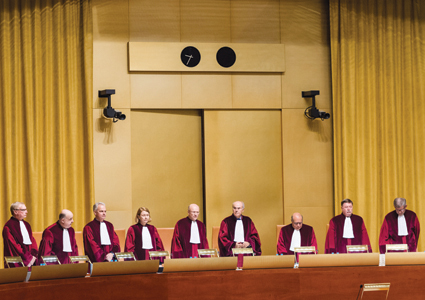
 A supra-national institution: The European Court of Justice in Luxembourg provides a “sledgehammer” to litigants, say legal academics (©Geert Vanden Wijngaert/AP/PA Images)
It goes without saying that we all believe in democracy. And that’s the problem. We take it for granted. When there are complaints, we seek refuge in the popular Churchillian quotation, “Democracy is the worst form of government except for all the other forms that have been tried from time to time.”
In the early 1990s, the triumph of democracy seemed complete with the fall of the Soviet empire and the transition to multi-party elections in many parts of Africa and Latin America. Yet democracy has always been more fragile than it is presumed to be. Far from being triumphant today, it continues to be subject to serious challenge. We forget to our peril that this applies also to the United Kingdom.
Some of the threats to democracy are dramatic and obvious, particularly that of international terrorism and the ideologies that motivate it. Violence, war, foreign occupation and struggles over territory have meant that there are few countries which have not been torn apart and have enjoyed prolonged periods of stability. Turmoil is the unfortunate norm. Nor has the United Kingdom been exempt. For much of the 19th and early 20th centuries, conflict about Ireland was a prime factor in British party politics. In the 1960s, terrorism in Northern Ireland erupted again. The difficulty of defeating it, the loss of more than 3,500 lives between 1969 and 2001, the bombing of the hotel where Prime Minister Margaret Thatcher and her senior colleagues were gathered for the Conservative party’s annual conference in Brighton in 1984, and other outrages on the British mainland have led to an uneasy, unsatisfactory peace. The territorial integrity of the UK is far from assured, as demonstrated by the sweep of SNP victories in last May’s general election. Without an agreed and settled boundary, the basis of democracy within that disputed territory is potentially weakened.
There are a number of other threats to British democracy. They are all the more insidious because they are less obvious. Three of them will be highlighted here: inadequate electoral administration; constitutional confusion resulting from a loss of national sovereignty to supra-national institutions; and the additional assault on sovereignty from a growing body of “soft law” promulgated by international organisations. The last of these is perhaps the least noted and, for that reason, especially worthy of attention.
Inadequate electoral administration — a dry and technical topic, which for that reason receives far too little attention — is an essential problem I have already raised in recent issues of Standpoint. Since elections are the basis of democracy, it follows that the quality of electoral rules and the efficient management of those rules are vital. Who is legally qualified to vote and whether the electoral roll accurately lists those entitled to cast a ballot is the essential foundation of free and fair elections. It is equally important to ensure that the names of the dead, the unqualified and those who have moved to a different address are not listed.
Like this article? Share, save or print using the icons below:


Post your comment
More Features
- Euphoric Labour won’t win power led by a pied piper
- Don’t be ‘difficult’ — try ‘formidable’, Mrs May
- Enough is enough of terror — but also of our self-doubt
- Iraq’s Christians pray for help that never comes
- The Atlantic alliance may be broken beyond repair
- Catholic tastes: both English and European
- Brexit as myth: Exodus, Reckoning, or Sacrifice?
- A Decent Woman Betrayed By Her Gruesome Twosome
- Can Macron Save France — Or Is He Its Undertaker?
- Europe's Revival Is At Hand, Thanks To Brexit
- Is This The Most Important British General Election Since 1979?
- The New Europe Must Be About More Than Money
- Our Best Brexit Policy Is All-Out Free Trade
- The Bursting Of Our 'Kabubble' Fantasies
- Gambling On A Greater More Gracious Britain
- Xi Versus Trump: The Emperor And The Tycoon
- Can Trump Square The Circle On Fiscal Reform?
- Donald Trump And The Dividing Of America
- Theresa May Emerges From Thatcher's Shadow
- Not Tweets And Anger But Redoubled Vigilance
Popular Standpoint topics

- Time To Revisit The Two Cultures
- Opposites meet in the land of Scrugletopia
- The Battle Against The Philistines Never Ceases
- How The EU Elite Paved The Way For Populism
- Anything Dennett Can Do, Scruton Does Meta
- Why France Is Revolting Against The Ancien Regime
- Can Macron Save France — Or Is He Its Undertaker?
- A Decent Woman Betrayed By Her Gruesome Twosome