


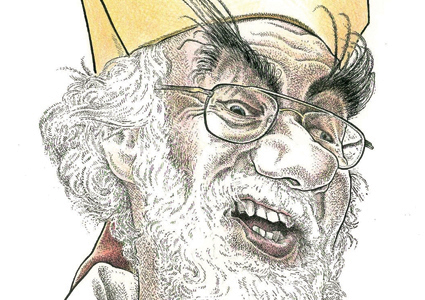
 (Illustration by Michael Daley)
Of all the modern thinkers who have been influenced by St Augustine of Hippo, from Pascal and Rousseau to Wittgenstein and Hannah Arendt, none ought to have been better qualified to follow in his footsteps than the former Archbishop of Canterbury, now Master of Magdalene College, Cambridge: Rowan Williams. He is widely acknowledged to have been one of the most distinguished theologians to have occupied the throne of the “other” Augustine — St Augustine of Canterbury, who converted the Anglo-Saxons. His study of the Bishop of Hippo, On Augustine, will be published by Bloomsbury in time for Easter. He has written some 40 books, reads nine languages and speaks three. Already Lady Margaret Professor of Divinity at 36, he was one of Mr Toad’s clever men at Oxford who know all that there is to be knowed. He is also a poet in the Celtic tradition of his countrymen and a life peer.
And yet Dr Williams is overrated. It is a harsh judgment on such a clubbable cleric, whose sibilant voice and Druidic beard made him instantly recognisable, who did his best to adapt the Church of England to the secular new saeculum, and whose public visibility gave a whole new meaning to the Anglican via media. Yet prelates are not there to be liked. As Primate of All England, Dr Williams was supposed to offer spiritual leadership to the nation. How well did he discharge his duties? As one of Britain’s most fêted public intellectuals, he has been a ubiquitous Christian presence in hostile company; but he is often merely a token presence. Typically, Dr Williams is more concerned to accommodate “the Other”, however inimical, than to assert the truth of his own creed. He has rarely mounted a vigorous defence of what is, after all, not only his personal faith, but the established religion of the land. Nor has he always seemed eager to stand up for the public role of the Church — now finally abandoned by Baroness Butler-Sloss’s Commission on Religion and Public Life.
As Archbishop of Canterbury from 2002 to 2012, he sometimes seemed to do the opposite. Most notoriously, in 2008 he declared that the adoption of Sharia law in Britain “seems unavoidable”; Muslims should not have to accept that “there’s one law for everybody”. Though criticised, he refused to retract views shared by Lord Phillips, the Lord Chief Justice and later President of the Supreme Court. Their advocacy undoubtedly facilitated and accelerated the spread of Sharia courts or “councils”.
Such acquiescence in what some might see as the relinquishing of England’s Christian patrimony fits with his vehement opposition to Western intervention in the Middle East. In 2007 he denounced US action against Syria as “criminal, ignorant and murderous folly”. Dr Williams has been consistent in siding against the West since his youthful support for the Campaign for Nuclear Disarmament. Unlike his predecessor, George Carey, he has seldom gone out on a limb for persecuted Christians. Unlike his successor, Justin Welby, Dr Williams never really left his previous profession behind.
Like this article? Share, save or print using the icons below:


- Time To Revisit The Two Cultures
- The Battle Against The Philistines Never Ceases
- Who Will Do Justice To Our Judiciary?
- How The EU Elite Paved The Way For Populism
- Trump's Appeal Is More Roosevelt Than Reagan
- Anything Dennett Can Do, Scruton Does Meta
- Why France Is Revolting Against The Ancien Regime
- A Letter To Our Great-Grandchildren
5:12 PM