



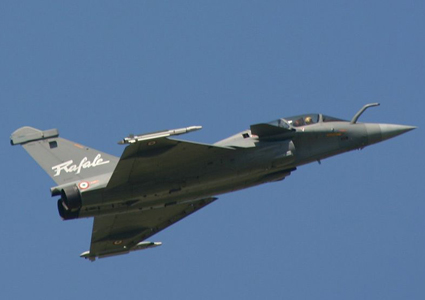
 A Rafale fighter jet: Targeting IS with air strikes will do nothing to weaken Assad's regime (photo: Arnaud Gaillard CC-BY-SA-1.0)
With Royal Air Force Tornados and Typhoons finally taking to the Syrian skies alongside French Mirages and Rafales, and President Obama addressing the nation on America’s role in the fight against Islamic State, you might be misled into believing that the cavalry is finally coming. It is not. When it comes to the Levant, the West will continue to sit on the fence. There will be no dramatic reassessment of its Syria policy; there will be no acknowledgement that Iraq is no longer a state; and there will be no game-changing commitment to supply Kurdish forces in northern Iraq with a qualitative edge in their fight against IS.
Nothing, then, is changing on the ground to dramatically alter the picture in Syria and Iraq.
First, French and British aircraft targeting IS will do nothing to weaken Bashar al-Assad’s regime. The September offensive launched by Assad’s loyalist forces, with the fresh infusion of troops, weapons, and air cover provided by the Lebanese Hezbollah, Iran’s proxy, and Russia’s deployment in the Latakia coastal region, has blunted the rebels’ offensive against the regime. Russia is busy pounding anti-Assad groups and, although the joint Russian-Syrian-Iranian advance on Aleppo has not been as smooth and fast as expected, the regime has regained ground and breathing space. With the help of Russia and Iran, Assad’s systematic campaign of ethnic cleansing in the Sunni heartland continues apace, with Russian steel now pairing up with the regime’s barrel bombing in the random targeting of civilians and the consequent exodus of refugees toward safer shores.
Second, no Western government intends to deploy troops against IS, save for a handful of special forces and military advisers whose role is not to engage in combat. Obama’s insistence on not returning American troops to Mesopotamia is an article of faith that undermines his rhetorical commitment to defeating IS. His vision is predicated on the mistaken belief that an air campaign will suffice to achieve the objective of defeating IS while avoiding Western casualties or, worse, stoking the flames of Islamic extremism. Belief in the effectiveness of air campaigns harks back to the 1991 Desert Storm operation to liberate Kuwait from Saddam Hussein and the 1999 Operation Allied Force in Kosovo. In Kuwait, the six-week-long pounding of Iraqi defences paved the way for a smooth 100-hour ground force operation that met little resistance. In Kosovo, the air campaign softened Serbian resistance even more, dispensing with the need for a military invasion.
Yet Obama, like France’s President François Hollande and British Prime Minister David Cameron, should know from their countries’ intervention in Libya that air campaigns do not necessarily deliver decisive results, let alone the post-conflict order that such military operations aspire to achieve when they are launched. After all, IS has been the target of thousands of air strikes since it captured Mosul in June 2014. Yet there is no sign of IS folding; or of a loss of appeal to foreign recruits; or of its military being degraded; or of any difficulty in obtaining financial resources to sustain itself.
Like this article? Share, save or print using the icons below:


Post your comment

- Why On Earth Should Anyone Study Philosophy?
- The Dying Days Of Zuma's South Africa
- His Master's Voice: Scruton On Wagner
- Political Misconduct
- Why The Most Civilised Of Men Felt Like A Fraud
- Cicero's Analysis Of Decline Offers Lessons For The West
- Andalusia Was No Golden Age
- Trump's Appeal Is More Roosevelt Than Reagan