


Trumpery is an archaic word for fraud, taken from the French tromper, to deceive somebody. Shakespeare puts it into the mouth of his rogue Autolycus, who boasts of defrauding the gullible with his worthless trinkets: “Ha, ha! What a fool Honesty is! And Trust, his sworn brother, a very simple gentleman! I have sold all my trumpery . . .” (A Winter’s Tale, Act IV, Scene IV.)
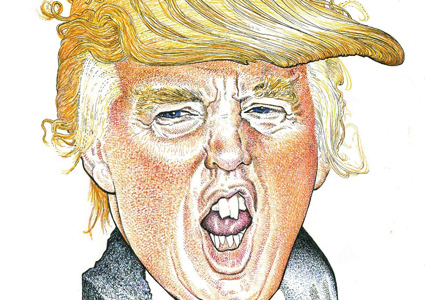 (Illustration by Michael Daley)
The dictionary definition of Trumpery is threefold:
In all three senses, “Trumpery” denotes the bill of goods that Donald Trump is seeking to sell to America. The subject of this essay, indeed, is not Trump the man, but the meaning of Trumpery. Millions of words have been devoted to the political, psychological and satirical dissection of the Donald, but far fewer to the cultural phenomenon of Trumpery. What we are witnessing is more than the rise of an individual, mesmerising though he may be, not only to Americans, but to the entire free world. Trumpery is the cult of a personality, certainly, but it is also the ascendancy of a cast of mind, a climate of opinion, a broadly-based sociological fact. Never before have we witnessed such a prodigious confidence trick perpetrated on the most powerful and prosperous people on the planet. The free world looks on in bewilderment at the prospective triumph of Trumpery in the land that gave us pragmatism.
Trumpery is the revenge of the rejected in more ways than one. Though Trump himself disclaims ideology, he is in fact one of the “madmen in authority, who hear voices in the air” evoked by Keynes: they “are distilling their frenzy from some academic scribbler of a few years back”. More by osmosis than by design, he has picked up the ideas of Reagan’s former communications director, Pat Buchanan, and his “paleoconservatives”. Buchanan ran three times for the presidency between 1992 and 2000, but he fell out with mainstream Republicans, while relishing the notoriety provoked by his thinly-disguised anti-Semitism. The paleocons’ ideology of “nativism, protectionism and isolationism” was dismissed in 1996 as “a philosophical corpse” by Charles Krauthammer, the neoconservative Washington Post columnist. Now the paleocons are back with a vengeance, in the guise of Trumpery. Conspiracy theorists, kooks and crazies of all kinds flock to the Donald’s banners, from David Duke and the Ku Klux Klan to Louis Farrakhan and the Nation of Islam. But so, too, do millions of decent, law-abiding, God-fearing Americans, oblivious of Trumpery’s dubious, even nefarious pedigree.
(Illustration by Michael Daley)The dictionary definition of Trumpery is threefold:
1. Worthless thing: Often something showy that seems appealing at first glance.
2. Nonsense: Empty or ridiculous talk.
3. Deception: The deceiving of somebody, or schemes conceived for the purpose of deceiving.
In all three senses, “Trumpery” denotes the bill of goods that Donald Trump is seeking to sell to America. The subject of this essay, indeed, is not Trump the man, but the meaning of Trumpery. Millions of words have been devoted to the political, psychological and satirical dissection of the Donald, but far fewer to the cultural phenomenon of Trumpery. What we are witnessing is more than the rise of an individual, mesmerising though he may be, not only to Americans, but to the entire free world. Trumpery is the cult of a personality, certainly, but it is also the ascendancy of a cast of mind, a climate of opinion, a broadly-based sociological fact. Never before have we witnessed such a prodigious confidence trick perpetrated on the most powerful and prosperous people on the planet. The free world looks on in bewilderment at the prospective triumph of Trumpery in the land that gave us pragmatism.
Trumpery is the revenge of the rejected in more ways than one. Though Trump himself disclaims ideology, he is in fact one of the “madmen in authority, who hear voices in the air” evoked by Keynes: they “are distilling their frenzy from some academic scribbler of a few years back”. More by osmosis than by design, he has picked up the ideas of Reagan’s former communications director, Pat Buchanan, and his “paleoconservatives”. Buchanan ran three times for the presidency between 1992 and 2000, but he fell out with mainstream Republicans, while relishing the notoriety provoked by his thinly-disguised anti-Semitism. The paleocons’ ideology of “nativism, protectionism and isolationism” was dismissed in 1996 as “a philosophical corpse” by Charles Krauthammer, the neoconservative Washington Post columnist. Now the paleocons are back with a vengeance, in the guise of Trumpery. Conspiracy theorists, kooks and crazies of all kinds flock to the Donald’s banners, from David Duke and the Ku Klux Klan to Louis Farrakhan and the Nation of Islam. But so, too, do millions of decent, law-abiding, God-fearing Americans, oblivious of Trumpery’s dubious, even nefarious pedigree.
Like this article? Share, save or print using the icons below:


More Features
- Can Macron Save France — Or Is He Its Undertaker?
- Europe's Revival Is At Hand, Thanks To Brexit
- Is This The Most Important British General Election Since 1979?
- The New Europe Must Be About More Than Money
- Our Best Brexit Policy Is All-Out Free Trade
- The Bursting Of Our 'Kabubble' Fantasies
- Gambling On A Greater More Gracious Britain
- Xi Versus Trump: The Emperor And The Tycoon
- Can Trump Square The Circle On Fiscal Reform?
- Donald Trump And The Dividing Of America
- Theresa May Emerges From Thatcher's Shadow
- Not Tweets And Anger But Redoubled Vigilance
- Why France Is Revolting Against The Ancien Regime
- How The EU Elite Paved The Way For Populism
- Trump's America: The End Of Exceptionalism
- The Kaliningrad Contingency
- Mrs May Is Too Canny To Say Farewell To Arms
- To Understand Trump, Read Huxley — Not Orwell
- A Letter To Our Great-Grandchildren
- Trump Is No Loser, But Government Will Be Harder
Popular Standpoint topics

- Time To Revisit The Two Cultures
- The Battle Against The Philistines Never Ceases
- Who Will Do Justice To Our Judiciary?
- How The EU Elite Paved The Way For Populism
- Trump's Appeal Is More Roosevelt Than Reagan
- Anything Dennett Can Do, Scruton Does Meta
- Why France Is Revolting Against The Ancien Regime
- A Letter To Our Great-Grandchildren
11:05 PM
11:03 PM
4:03 PM