


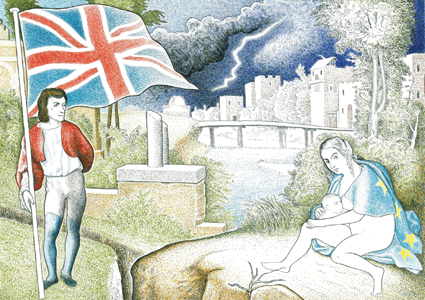
 Summer of discontent? (Illustration by Michael Daley, after Giorgione)
The European question has been given a decisive answer by the British people. We believe it was the right one. And it is final. Three other questions remain. Why did it happen? What does it mean? And what will happen next?
In a prompt, dignified and justified resignation speech, David Cameron declared that the country required fresh leadership. He is correct: it was indeed his failure to lead the whole country, rather than just the metropolitan elites, that brought about his downfall. The referendum revealed all too clearly a division between the Haves and the Have-Nots, between those privileged by and those deprived of higher education, suggesting that Britain is hardly less divided than it was in 1845 when Disraeli warned of two nations “between whom there is no intercourse and no sympathy”. It was Chesterton who took up Disraeli’s critique: “Smile at us, pay us, pass us; but do not quite forget. / For we are the people of England, that never have spoken yet.”
Well, the people have spoken now. Two duumvirates — Blair and Brown followed by Cameron and Osborne — have presided over the widening and deepening of this chasm. Europe has been the catalyst for this latter-day peasants’ revolt. Lord Mandelson spoke for the self-appointed, self-aggrandising Europhile aristocracy when he dismissed the electorate’s verdict as “the worst day in post-war British history”. It didn’t feel like that for the masses of ordinary people who have now found their voice. For the people who woke up to find themselves living in a free country again, the defeat of the Europhile nobility feels like a liberation, even a revolution.
What does this result mean? It has been above all a vindication for two women: one alive, one dead. The Queen was enlisted on the Leave side early in the campaign, a claim firmly denied by the Palace. But there was no denial when later she was quoted as having asked her guests: “Give me three good reasons why Britain should be part of Europe.” That was a clear signal that the Queen shares the Euroscepticism of the majority of her generation. Another member of that generation was Margaret Thatcher. Brexit was her posthumous triumph. Such a bouleversement might never have happened but for her inspirational articulation of the case against a European superstate.
For the moment, those who voted Leave, usually for reasons no less noble or unselfish than the other side, are being made to feel as if they had betrayed their country. The colossal condescension of the rulers to the ruled has mutated into fury. Europe, it turns out, was always a moral issue even more than an economic one. Since the result, expressions of social and intellectual snobbery towards the Leave regions have proliferated in the echo chamber of social media. Such malice would have shamed our Victorian ancestors. The hideous murder of the Yorkshire MP Jo Cox quite rightly shocked the nation; yet the Remain campaign tried to blame their opponents for an act of terrorism. The attempt failed, but it left a toxic legacy. The referendum had a high turnout and a clear result. It seems, however, that some of us have forgotten how to be good losers. A petition for a second referendum is doing the rounds; others are proposing to hijack the Conservative Party by the same entryist tactics that enabled Jeremy Corbyn to become Labour leader. Some will stop at nothing to stop Brexit.
Like this article? Share, save or print using the icons below:


- Time To Revisit The Two Cultures
- The Battle Against The Philistines Never Ceases
- Who Will Do Justice To Our Judiciary?
- How The EU Elite Paved The Way For Populism
- Trump's Appeal Is More Roosevelt Than Reagan
- Anything Dennett Can Do, Scruton Does Meta
- Why France Is Revolting Against The Ancien Regime
- A Letter To Our Great-Grandchildren
2:07 PM
1:07 PM
1:07 PM