



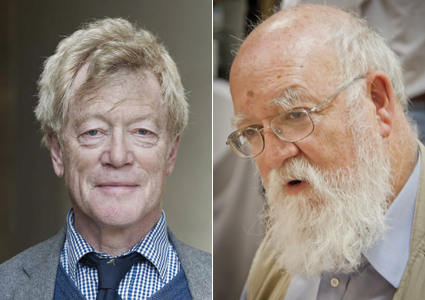
 Sir Roger Scruton (left) and Daniel Dennett: Suppliers of “thinking tools” (Left: ©Princeton University Press, right: Dmitry Rozhkov CC BY-SA 3.0)
Years ago, I fell in love with the body, and especially with the brain: once acquainted with them, who could fail to marvel at the elegance of their parts, the complexity of their workings, their miraculous processes of growth? Yet after months in medical school absorbed by anatomy, biochemistry, pathology I began to feel that something, or possibly someone, was missing: our first lecture by a psychiatrist, who spoke of the feelings and thoughts of whole people, gave me an extraordinary sense of homecoming. John Martin, academic cardiologist and poet, once captured this tension precisely: “I take apart their insides, discover the insides of their insides, until I know the atoms of the molecules that make the cells stick. But where is man desiring beauty?” The question of where we should turn in understanding ourselves, whether to the personal or the sub-personal, lies at the heart of two sharply contrasting but closely related new books by two distinguished philosophers from either side of the Atlantic.
Roger Scruton’s On Human Nature (Princeton, £18.95) expands on a series of lectures given at Princeton. It gives a brief, poetic account of a way of thinking about ourselves that many of us, especially with a background in the humanities, will find congenial. Scruton of course accepts that we are organisms, “human animals”, but believes that this truth, and the mechanistic and evolutionary inquiries that it inspires, fail to do justice to a more fundamental one: that we are “persons”, free, accountable, self-conscious, rational. He indicates that we could share this essence with beings that are not of this world — or, even, a little provocatively, “of the flesh”. As persons, we require a different “order of explanation” to that offered by biology: the study of our kind is the business of the humanities which offer interpretation, as opposed to the explanations offered by science.
Scruton eloquently evokes one of our key intuitions about ourselves, that we look out on the world from the vanishing centre of a private universe: “we are objects caught in the current of causality . . . but each human subject addresses us from the transcendental horizon of the ‘I’.” This human self, nonetheless, Scruton believes, is fundamentally social, and much of his book is devoted to his understanding of morality and the “negotiated terms” on which we live with one another. He discusses but dislikes the dominant current theories of “consequentialism” and “contractarianism” which find the basis of moral obligation either in a calculation of the likely effects of our actions or in level-headed agreements to coordinate our differing goals. He points out that most of our moral decisions involve the pressures created by our embodiment — he is particularly interested in sex — and by “ties that we never chose”. At the close of this short work he argues that we can only do justice to some of our moral emotions by invoking a concept of the sacred: we yearn for redemption, reaching out in moments of liminal experience — “falling in love, recovering from illness, becoming a parent” — towards “the soul of the world”.
Like this article? Share, save or print using the icons below:


- Time To Revisit The Two Cultures
- The Battle Against The Philistines Never Ceases
- Who Will Do Justice To Our Judiciary?
- How The EU Elite Paved The Way For Populism
- Trump's Appeal Is More Roosevelt Than Reagan
- Anything Dennett Can Do, Scruton Does Meta
- Why France Is Revolting Against The Ancien Regime
- A Letter To Our Great-Grandchildren
12:02 AM
10:02 AM
11:02 PM
5:02 PM
2:02 PM
2:02 PM