



"So maybe a week or so later, I get an invitation to dinner at Kizerman's son's apartment, where I'm to meet this broad who's caused my old pal to lose his normal good sense."
Gladys arrives, sets a bowl of kreplach soup before Kizerman and brings a cup of coffee for me. Kizerman plunges into his soup. He's one of those guys who can talk and eat without losing the rhythm of either. He'd already done a pretty good job on the bread basket. But I guess that's how you get to be 300 pounds or whatever he is.
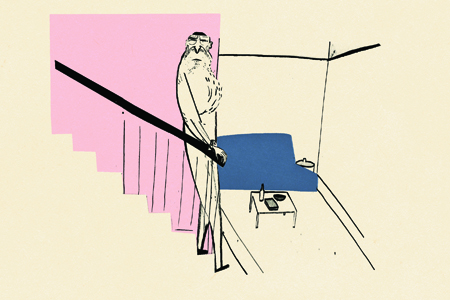
"Anyhow," says Feigenbaum, "at Kizerman's son's place I get to meet my old friend's new heartthrob. Her name is Deborah Shapiro. She's good-looking, expensively dressed, goes a little heavy on the warpaint, is obviously a woman still on the attack. The only other people there are Dr Gary Kastel (Kizerman's plastic-surgeon son, who did a bit of rhinoplasty on his own name), his wife Robin, and me. Kizerman is wearing a suit I haven't seen before, very Italian. He and Ms Shapiro stick close together. I get the strong impression that, jacked up on Viagra or something more powerful, he's canoodling her, if you take my meaning.
"At dinner she tells me that Harold has told her about our collaborating on a play together. I tell her we have been working on it for more than a year now and hope to have it performed at the retirement home where I live, and that it's a play about growing up in the Depression and its effects on two young boys with artistic instincts, sending them into the business world.
"‘I'm a big fan of Hal's poems,' she says.
"I ask her about her own life. She says that her father was a liquor distributor. Her maiden name was Weiss. The family lived in West Rogers Park. She went to Mather High School. Shapiro, her third husband, did something with fire insurance that wasn't clear to me, but didn't sound quite strictly on the up and up. Her second husband died of congestive heart failure, four years ago, at 78. Which suggests that maybe she has a thing for older men, a father complex maybe, who knows? About her first husband she didn't speak."
Feigenbaum has by now finished off his soup with their two large kreplach. ("They're Brobdignagian, Daddy," Sheryl, my youngest daughter, the English major, used to call our kreplach.) Gladys arrives, and sets before him his brisket sandwich and fries and Dr. Brown's.
"But I sensed," Feigenbaum says, "something out of kilter. I looked at her and thought, this is a woman whose life hasn't worked out. This is not a happy woman. Something has gone profoundly wrong for her. She's in choppy waters, adrift, and looking for something to cling onto to get to shore. My friend Hal maybe."
"What made you think that?" I asked.
Kizerman reached for another slice of pickle.
"Instincts," he says. "Disappointment is written in her eyes. Of course I said nothing about it. I kept my own counsel. The dinner went on. Pretty dull talk, I thought, but not for my old friend Kizerman. You could tell he was delighted to have been taken up by a still good-looking woman more than 20 years younger than himself. You reach a certain age, you no longer think of yourself as in the hunt, if you know what I mean.
"Anyhow," says Feigenbaum, "at Kizerman's son's place I get to meet my old friend's new heartthrob. Her name is Deborah Shapiro. She's good-looking, expensively dressed, goes a little heavy on the warpaint, is obviously a woman still on the attack. The only other people there are Dr Gary Kastel (Kizerman's plastic-surgeon son, who did a bit of rhinoplasty on his own name), his wife Robin, and me. Kizerman is wearing a suit I haven't seen before, very Italian. He and Ms Shapiro stick close together. I get the strong impression that, jacked up on Viagra or something more powerful, he's canoodling her, if you take my meaning.
"At dinner she tells me that Harold has told her about our collaborating on a play together. I tell her we have been working on it for more than a year now and hope to have it performed at the retirement home where I live, and that it's a play about growing up in the Depression and its effects on two young boys with artistic instincts, sending them into the business world.
"‘I'm a big fan of Hal's poems,' she says.
"I ask her about her own life. She says that her father was a liquor distributor. Her maiden name was Weiss. The family lived in West Rogers Park. She went to Mather High School. Shapiro, her third husband, did something with fire insurance that wasn't clear to me, but didn't sound quite strictly on the up and up. Her second husband died of congestive heart failure, four years ago, at 78. Which suggests that maybe she has a thing for older men, a father complex maybe, who knows? About her first husband she didn't speak."
Feigenbaum has by now finished off his soup with their two large kreplach. ("They're Brobdignagian, Daddy," Sheryl, my youngest daughter, the English major, used to call our kreplach.) Gladys arrives, and sets before him his brisket sandwich and fries and Dr. Brown's.
"But I sensed," Feigenbaum says, "something out of kilter. I looked at her and thought, this is a woman whose life hasn't worked out. This is not a happy woman. Something has gone profoundly wrong for her. She's in choppy waters, adrift, and looking for something to cling onto to get to shore. My friend Hal maybe."
"What made you think that?" I asked.
Kizerman reached for another slice of pickle.
"Instincts," he says. "Disappointment is written in her eyes. Of course I said nothing about it. I kept my own counsel. The dinner went on. Pretty dull talk, I thought, but not for my old friend Kizerman. You could tell he was delighted to have been taken up by a still good-looking woman more than 20 years younger than himself. You reach a certain age, you no longer think of yourself as in the hunt, if you know what I mean.
Like this article? Share, save or print using the icons below:


Post your comment
More Text
- Liberty And Sovereignty
- Art And Public Culture In The 1830s And Today
- The Casanova Of LaSalle Street
- The Writer
- New Poetry
- Cartagena Poems
- A British Subject
- Travels with Betjeman
- Communism’s Comeback?
- Irving Kristol on Jews and Judaism
- The State of Charity
- Teeth
- La Buena Muerte
- Judaeophobia
- Cool It
- Rachmones
- From 'Russia'
- 'Going Out' and Five Other Poems
- The Final Edition
- 'The Ship of Endurance' And Three More New Poems
Popular Standpoint topics
