


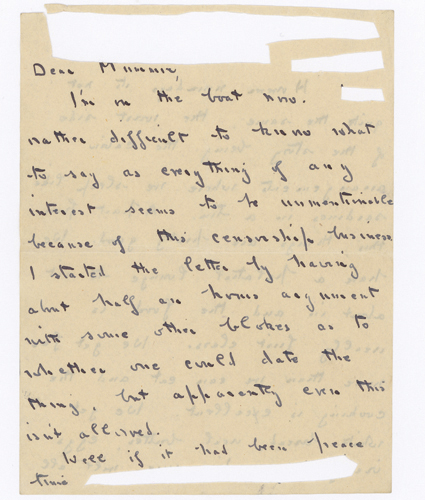
One of Brian Sinclair’s (censored) letters to his mother: He treated her as a friend, confiding in her about the existence of his girlfriends
Another grave, for another young soldier, bore a verse from his parents which said that he had served his earthly king, and his divine king had found need of him. Then a full stop, and the words. “Our son.”
At the entrance to the cemetery there is a great wide stone where you read: “Their name liveth for evermore.” It is a beautiful cemetery. It is immaculately kept, even if its once tranquil location is changed by a cement plant on one side and some other industrial activity on the other. It looks, for now at least, straight to the mountains. The purity and order of the white stones is a blazing statement. There is a great high, white, slender cross at the back in the centre, behind an expanse of perfect grass that separates the plots of white stones and gives a sense of space and honour and propriety. It seemed to me, thinking about it afterwards, that, indeed, to be buried in such a place does mean their name will live on, while we in our little country churchyards, or, more likely, our municipal crematoria, will sink into obscurity and oblivion. Let us hope so. The state may be fickle, but the army, as long as it exists, is loyal.
I photographed Brian’s headstone, and those of his two Christmas comrades, and the cemetery itself with the mountains beyond. I read the history which the War Graves Commission has erected at the perimeter, and the book of remembrance. Not long before, some Dutch people had written in it: “We will never forget.” I wrote: “Niece of Lt. Brian Sinclair. With gratitude, love, honour and always remembrance.”
Like this article? Share, save or print using the icons below:


Post your comment
More Text
- The Viagra Triangle
- Two Languages And The Chasm Between Them
- Western Civilisation In Crisis
- The Man On Whom Everything Was Lost
- The Long Shadow Of Malthus
- Beyond Obama: Advice To The Next President
- Saved From The Bonfire: The Tom Wolfe Papers
- Liberty And Sovereignty
- Art And Public Culture In The 1830s And Today
- The Casanova Of LaSalle Street
- The Writer
- New Poetry
- Cartagena Poems
- A British Subject
- Travels with Betjeman
- Kizerman and Feigenbaum
- Communism’s Comeback?
- Irving Kristol on Jews and Judaism
- The State of Charity
- Teeth
Popular Standpoint topics
