



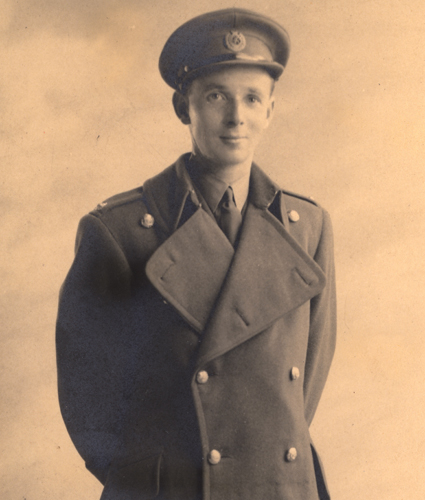
Lieutenant Brian Sinclair of the Royal Engineers: His war service was the antithesis of aggression, rescuing the injured and defusing bombs
SEPTEMBER 19
I am back in Venice. It is cooler, comfortable. Yesterday at 2.30pm I put my feet in the warm, dirty Salerno sea. Walking back from the beach, the paving stones were too hot to stand on with bare feet. I picked up a stone from the sand: almost heart-shaped, but with a top curve broken off.
I wept again at a café with Stephen as we drank a cold beer, waiting for our train home. My heart was so full that at a word from him it poured over. The previous day when I tried to sign and write in the book of remembrance at the cemetery, my hand was shaking, and legibility was a great effort.
To reach the cemetery we had hired a “private” taxi arranged by a sweet-natured but unstoppably garrulous woman who looked after the B&B. He had agreed to pick us up at 9.30 and wait if we liked until 12 noon, when apparently the car was needed for the afternoon. The road we took, I realised, was the road the convoy of dead bodies would have taken to Pontecagnano. I imagined the rumble of the army lorries. My grandmother never visited Salerno. She had a nervous collapse in 1944, and for the rest of her life was unable to face the ordeal. Nor could my mother. They were wise, I now realise. This young man, by his absence, occupied a major space in my childhood imagination and does so to this day. That is why I came, now more than twice his age when he died, to see him.
The taxi driver had a kind and feeling face, and he did wait. Out of the corner of my eye I saw him cross himself at the gates of the cemetery, after he had opened the car door to let me out. Stephen had promised to leave me to myself, and dropped back, I think to look at the information framed at the perimeter, and the book of remembrance housed in a small, stone, shrine-like structure near the gate.
I had the address of the grave: Plot 3, Row D, Number 39. I had looked at the cemetery plan on the internet, and worked out exactly where he was. I made my way over to it. It was not his. The first grave in row D, approaching from the left side, was of “A Soldier of the Second World War”, and I suddenly worried that perhaps his grave was marked in this way and I wouldn’t know where he was. I walked my way along the row, and then came upon it near the other end. There was the reality. I was the first family member to see it in 71 years. An encounter. A sense of relationship, but a realisation of a gulf. There he is, among his comrades, six of whom were blown up by the same bomb, buried in the same row.
The simple tombstone seemed so cool compared with the warm, living being in the letters I had been reading. I tried to talk to him but felt I lacked status and felt silly and unqualified to speak. Those he loved are now dead. I pray they are with him and he with them. I needed say nothing on their behalf. In the end I wrote on a piece of paper and the gardener buried it for me in the earth just in front of the stone. Later I said the Lord’s Prayer. I said I would come back.
Like this article? Share, save or print using the icons below:


Post your comment
More Text
- The Viagra Triangle
- Two Languages And The Chasm Between Them
- Western Civilisation In Crisis
- The Man On Whom Everything Was Lost
- The Long Shadow Of Malthus
- Beyond Obama: Advice To The Next President
- Saved From The Bonfire: The Tom Wolfe Papers
- Liberty And Sovereignty
- Art And Public Culture In The 1830s And Today
- The Casanova Of LaSalle Street
- The Writer
- New Poetry
- Cartagena Poems
- A British Subject
- Travels with Betjeman
- Kizerman and Feigenbaum
- Communism’s Comeback?
- Irving Kristol on Jews and Judaism
- The State of Charity
- Teeth
Popular Standpoint topics
