



It was a poisoned chalice: he got into severe trouble for taking a forward line in ordering UN forces to combat Tshombe's secessionist campaign in Katanga. His involvement there, and his denunciation of British and Rhodesian policy, along with upheavals in his private life, led to his severance from the official diplomatic world - a parting made permanent by his scorching apologia, To Katanga And Back. (Simon & Schuster, 1962. It became known in the Thurber-reading Cruise O'Brien household as "The Year The Bed Fell On Father".) But his role in the debacle was largely vindicated by time and went down well in some quarters: the Observer under David Astor, for instance, and several new African states. Kwame Nkrumah invited him to become vice-chancellor of the University of Ghana, an association where neither side (like Hammarskjöld a year or so before) quite realised what they were getting. O'Brien relinquished it with some relief after three years. His subsequent career involved prestigious university posts, an interlude as a front-rank politician (Irish Labour Party TD, and Minister of Posts and Telegraphs in the Fine Gael-Labour coalition government of the early 1970s), some years as editor-in-chief of the Observer, and a continual stream of books, essays, articles, lectures and journalism. His political interventions were controversial (notably in censoring republican spokespeople on RTE) but he did not possess the gladhanding camaraderie (or simple tact) required for Irish politics, and his influence was limited. His op-ed columns for The Observer, on the other hand, were classics and helped create the genre as we know it. He also wrote polemical drama, and I suspect there must be a draft novel in a drawer somewhere; if so, it would be more like Orwell than Sartre. Nevertheless, the position he held was that of a public intellectual, very much in the French mould - a syndrome with which he was intimately familiar, as the author of a series of luminous essays on Catholic writers and politics, published as Maria Cross. It is a métier less familiar in the English-speaking world, though perhaps more comprehensible in Dublin than London. But his fellow-countrymen (like his employers in various spheres) never knew quite what to do with him.
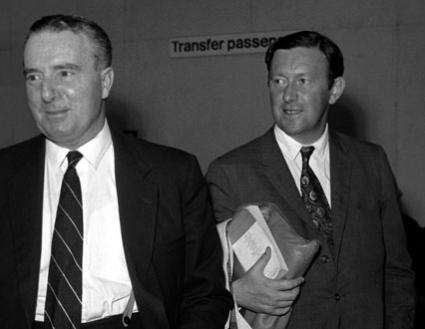
O'Brien the diplomat in Katanga (Getty)
They took refuge, as so often, in a nickname, "The Cruiser" - coined by a brilliant but vitriolic political journalist who subscribed to more unreconstructed and Anglophobic beliefs than Conor's. The sobriquet was meant to denote opportunism and unpredictability, but to his admirers it suggested a more apposite image: a threatening warship, covering the territory of Dublin Bay, its big guns trained on the flimsy defences of official piety. Nor were his targets merely politicians. Early on, he zoned in on the political attitudes which often underlie aficionados of the "post-colonial" interpretation of Irish culture, enjoying some rough fun with a book published in 1985 and unwisely titled The Irish Mind. Its editor, O'Brien remarked in the Times Literary Supplement, seemed to want to establish that Irish people can think: "A curious, even an abject thing to want to prove, but there it is." He went on to point out that Burke and Berkeley were, in fact, intimately associated with the colonial enterprise that the volume's contributors claimed generated only "servile discourse" from those not intellectually liberated like themselves. Thus Conor only could conclude that "intellect seems to do better in captivity". Finally, those big guns opened up: "The politics, now defined as ‘anti-colonial', and larded with Third Worldly quotations from the school of Frantz Fanon, is really good old Catholic Irish nationalism, in trendy gear. These cultural nationalists are the latest generation of what used to be called ‘the literary arm of the movement' - a term formerly employed, with genial derision, by the military leaders of the movement in question, the IRA."


- Teeth
- La Buena Muerte
- Judaeophobia
- Cool It
- Rachmones
- From 'Russia'
- 'Going Out' and Five Other Poems
- The Final Edition
- 'The Ship of Endurance' And Three More New Poems
- The Letters Of Hugh Trevor-Roper
- Lighten Our Darkness
- Poetry
- Folie à Dieu
- New Poetry
- Adultery?
- Reece Mews
- Robin
- Two New Poems
- Three New Poems
- Freedoms We Risk Losing

- Conduct Unbecoming: The Classical Commentaries of Norman Lebrecht in Standpoint
- Propaganda Shouldn’t Pay
- The US Can Still Help Save Syria — and Iraq
- A Putrid Pact between Devils
- Strangers in their own Holy Land
- The Taboo of the Tombola
- Putin has his Useful Idiots on the Left and the Right
- Russian Resurgence has Blindsided Nato
3:02 PM
12:02 PM
2:02 PM
3:02 PM