


As an historian, and a student of human nature and public life, he might not have been surprised. As an historian, too, he might have noted how clearly Irish government papers released under the 30-year rule have vindicated the O'Brien analysis of public attitudes and private doublethink in the 1970s. Southern politicians dreaded and feared the awakening of the northern Kraken, civil servants in Dublin wrote pungent memoranda about the damaging hypocrisy of anti-partitionist propaganda and the need to build reassuring relationships with Northern unionism, but in public politicians danced through the steps of the traditional Reunification Reel. The parallels with the governing hypocrisies about speaking the Irish language were obvious - another of O'Brien's pet subjects. "The Gaelic Revival Movement," he wrote in the Irish Independent in 1991, "failed to revive, and its only movement was backwards. But it did generate a huge amount of political hypocrisy and - what was worse, because more insidious - a habit of listening to official nonsense, in an approving sort of way, as you might listen to the prattle of an innocent child."
What made such statements all the more infuriating to the Irish bien-pensant was that he was uniquely qualified to make them. He was a fluent Irish-speaker, married to Máire Mac an tSaoi, one of the most distinguished poets in the Irish language and his doughty defender in many a battle. His own family background was saturated in the values of the Revival. His father Francis, who died when Conor was ten, was a brilliant nationalist journalist, and his mother Kathleen came from a prominent nationalist political dynasty, the Sheehys. James Joyce was a Sheehy family friend and Kathleen supplied the model for Miss Ivors in Joyce's greatest short story, The Dead, while Conor's grandmother appears by name in Ulysses. His aunt, Hanna Sheehy Skeffington (who seems to have terrorised his youth) was a significant figure in the history of early-20th-century Irish feminism and republicanism. A strain of secularism and mild anti-clericalism within his own family impelled his parents to send him to a non-denominational school, and then Trinity College, though both Conor and his older cousin Owen Sheehy-Skeffington (a key early influence) maintained firm nationalist attitudes in the face of occasional West British survivals around them. At the same time, through his first marriage to Christine Foster he knew the world of middle-class Northern Protestantism (albeit in its most liberal vein). And for his doctoral subject he chose the then unfashionable subject of Parnellite politics - looking back to the era of constitutional nationalism before the 1916 Rising changed everything utterly.
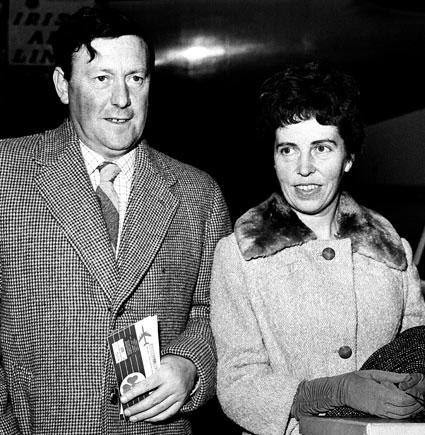
O'Brien with his wife Máire Mac an tSaoi (Getty)
The book that emerged from this, Parnell and his Party, remains an indispensable classic half a century after its first publication. It supplies a profound analysis of power and charisma in democratic politics, owing more to Pareto and Weber than its first readers perhaps expected. It also gave serious attention to W.B. Yeats's contribution to the creation of political myth, thus anticipating a later interest (and another controversy). But O'Brien did not enter academe, though he went on writing coruscating literary and political commentary under the pseudonym of Donat O'Donnell. He joined the Irish Department of External Affairs, at one point serving under the Machiavellian Sean MacBride as Foreign Minister: MacBride's pretensions and prejudices, like those of his mother Maud Gonne, supplied Conor with rich satirical copy for the rest of his life. He then became a member of the Irish delegation to the UN in the late 1950s, where his opinions were considered dangerously left-wing. But the secretary-general, Dag Hammerskjöld, liked what he saw and was responsible for O'Brien's secondment to the recently-independent Congo.


- Teeth
- La Buena Muerte
- Judaeophobia
- Cool It
- Rachmones
- From 'Russia'
- 'Going Out' and Five Other Poems
- The Final Edition
- 'The Ship of Endurance' And Three More New Poems
- The Letters Of Hugh Trevor-Roper
- Lighten Our Darkness
- Poetry
- Folie à Dieu
- New Poetry
- Adultery?
- Reece Mews
- Robin
- Two New Poems
- Three New Poems
- Freedoms We Risk Losing

- Conduct Unbecoming: The Classical Commentaries of Norman Lebrecht in Standpoint
- Propaganda Shouldn’t Pay
- The US Can Still Help Save Syria — and Iraq
- A Putrid Pact between Devils
- Strangers in their own Holy Land
- The Taboo of the Tombola
- Putin has his Useful Idiots on the Left and the Right
- Russian Resurgence has Blindsided Nato
3:02 PM
12:02 PM
2:02 PM
3:02 PM