


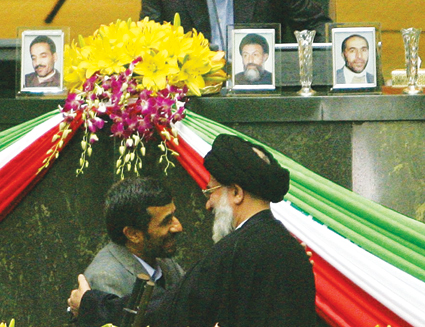
President Mahmoud Ahmadinejad embraces Ayatollah Khamanei (PA)
Hidden among platitudes on the peace-loving nature of all three monotheistic religions (particularly Islam), President Barack Obama referred in his 4 June Cairo speech, almost en passant, to what is probably the most critical strategic issue on the international agenda. Declaring his understanding of "those who protest that some countries have weapons that others do not", he said that "no single nation should pick and choose which nations hold nuclear weapons". At the same time, he qualified this "declaration of nuclear right" with the warning that a nuclear Iran would lead to "a nuclear arms race in the Middle East that could lead this region and the world down a hugely dangerous path". To Middle Eastern ears, the message was that American concerns do not derive from the threat that a nuclear Islamic Republic of Iran per se might pose, but from the consequent nuclearisation of Iran's Arab neighbours that might ensue.
The prospect of nuclear (Iran-Israel) or a "polynuclear" Middle East has been debated for some time in academic and policy circles, giving rise to a number of theories regarding the relevance of the lessons of the Cold War to such a situation. Some invoke the experience of the Cold War to argue that a "polynuclear" Middle East can still be averted. Others argue that a nuclear Middle East may even provide a more stable regional order based on the Cold War doctrine of "mutually assured destruction" (MAD).
Indeed, today we know that the Cold War was much less stable than it appeared to be and that cultural differences played a critical role in the behaviour of the parties to that conflict. This may prove to be even more so in the context of the Middle East. There are substantial cultural, religious, political and organisational differences between the Cold War protagonists and candidates for nuclear powers in the Middle East. This should raise questions regarding the probability of a Cold War-type strategic balance in the region and of the consequent risk of nuclear confrontation. These differences can be summarised in four key areas:
(1) The dynamics of regional proliferation that seem to make a nuclear arms race inevitable and increase the likelihood of transfer of nuclear weapons to non-state (terrorist) entities.
(2) The distinction between the Cold War paradigm of bipolar deterrence based on second strike and the multipolar situation in which no nation would have such a capability which will be the case in the Middle East.
(3) The role of religion or the level of rationality in political decisionmaking.
(4) Strong executive hierarchal command and control structures as opposed to diffuse multipolar "polycratic" regimes.
The first issue to address is whether a polynuclear Middle East can be averted. During the Cold War, countries such as Germany and Japan agreed to forego a military nuclear capability though they had sufficient technology to cross the threshold. In the case of Germany and Japan, this was achieved through extended assurances, guaranteeing American allies protection against attack by any other nuclear states as a substitute (which made political, economic and strategic sense) for maintaining their own nuclear arsenal. The Indian-Pakistani case also seems to offer a model of a nuclearisation of a sub-region that did not extend outside the region. One could argue for the application of these models to the Middle East, either by reaching a similar arrangement with the Islamic Republic on its capping its nuclear programme at a German/Japanese "threshold" status, or by offering broad (US) assurances to other Middle Eastern states in lieu of their acquiring their own nuclear weapons. The "German/Japanese model" seems to be increasingly gaining popularity in the US and Europe as it becomes clear that negotiations will not bring about a cessation of Iran's enrichment activities.


- Admit It, Mr Kerry: You Blundered
- Bismarck Versus Blair — A Foreign Policy Crossroads
- Arab Spring, Islamist Summer — What Next?
- The Diplomat the Whole World Ignores
- The Blob Has Run Schools For Decades. Not Any More
- Would You Intervene — Or Pass On The Other Side?
- He Died That Others Might Live In Peace
- The Hero's Journey is Hollywood's McMyth
- Online Only: Countering the Counter-Jihadists
- Online Only: The Price Paid for Criticising Islam
- 'Please Sir, I Just Want to Learn More'
- Why Students Should Be Glad To Pay Tuition Fees
- A 'Liberal Racist'? Me? I Felt Like a Heretic
- Demolish the Relics of Yesterday's Future
- Was Britain Right To Go To War In 1914?
- German Victorians Who Helped Transform Britain
- The Alternative History of an Undivided India
- Online Only: Heirs to the Left
- ONLINE ONLY: The Hayward Gallery's Fashionable Primitives
- ONLINE ONLY: A Spiritual Corner of Southwark

- The Zombie Argument that Refuses to Die
- Online Only: The Price Paid for Criticising Islam
- Overrated: Dan Brown
- Is the Brain the Key to Understanding Religion?
- Overrated: George Monbiot
- Time to Wise Up to the Muslim Brotherhood
- 'Please Sir, I Just Want to Learn More'
- The Alternative History of an Undivided India
- The Zombie Argument that Refuses to Die
- Online Only: The Price Paid for Criticising Islam
- Overrated: Dan Brown
- Is the Brain the Key to Understanding Religion?
- Overrated: George Monbiot
- Time to Wise Up to the Muslim Brotherhood
- 'Please Sir, I Just Want to Learn More'
- The Alternative History of an Undivided India
- Decline and Fall of the History Men
- Uncritical Theorists Who Misread the Nazis
- The Zombie Argument that Refuses to Die
- The Banality of Hannah Arendt
- From Kitsch to Cool: Picasso and Modern Art
- Is the Brain the Key to Understanding Religion?
- Time to Wise Up to the Muslim Brotherhood
- Midfield Virtuoso Finds His Perfect Pitch
6:09 PM