


The bulk of Nato forces behaved more like the Salvation Army than a fighting machine in a real war. US forces did some fighting in the south-eastern provinces, often by firing missiles from drones into Pakistan. British, Canadian and French units also did some fighting in the provinces entrusted to them, by reacting when attacked. However, they seldom took the initiative by actually going after the insurgents. Their measure of success was the number of children, especially girls, who went to school in areas protected by them, not the number of insurgents killed or captured.
The third phase started in 2008 when President George W. Bush sent additional troops, a move endorsed by his successor. Washington realised that there was a military problem that needed a military solution.
In a strategy developed by General David Petraeus, the US and its Nato allies redefined the mission as one of enforcing peace rather than keeping a nonexistent peace. Under the new strategy, the "live-and-let-live" policy, under which insurgents are allowed safe havens, will end. These safe havens, concentrated in the southern provinces of Kandahar, Helmand, Arzangan and Nimroz, as well as a few areas near Kabul and Kunduz in the north, are known to Nato but have been tolerated because the allies lacked the resources to destroy them.
Nato has about 90,000 troops in Afghanistan, a country the size of California. Of these, at least a third are non-combatant because of caveats imposed by their governments. That makes a division of labour imperative. Those non-fighting Nato troops must relieve the pressure on the fighting units by helping with policing, construction work and intelligence.
Even then, General McChrystal might find it hard to pursue the insurgents in a decisive manner with just 60,000 or so troops. Taking into account the need for rotation as well as logistical and administrative duties, the general might not have enough troops for a proper search-and-destroy strategy, even if we add British, Canadian and some French units.
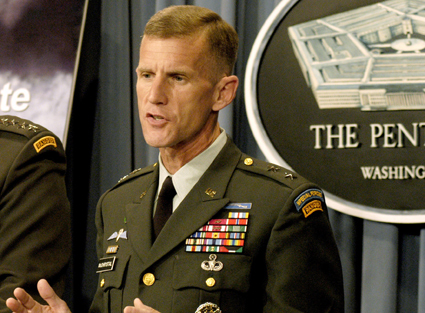
General Stanley McChrystal, who has demanded more troops
If President Obama intends to win his "war of necessity", he will have to increase the number of US troops to fight a war that might continue beyond his first term. Even then, General McChrystal must realise that his version of the "surge" might not secure all the troops needed. He would have to find allies inside Afghanistan, just as Petraeus did in Iraq.


- The US Can Still Help Save Syria — and Iraq
- Russian Resurgence has Blindsided Nato
- On Europe, Nothing Less than Treaty Change will do
- Putin has his Useful Idiots on the Left and the Right
- Sarajevo: Where the Century of Terror Began
- Allen Lane’s Pelicans Take Wing Once More
- How Not to Remember the First World War
- Opera is Not Just Our Most Expensive Noise
- Jonathan Miller: One Man, Two Cultures
- Without a Big Idea, Cameron Will Lose
- A Christian Country? No, a Conservative One
- How to Get School Competition Right
- The War on the Firmest Bulwark of our Liberty
- How Modern Liberals Created Nigel Farage
- Caught in the Trap of His Own Metaphysics
- In Search of My Father, Agent of the Comintern
- Geoffrey Hill and the poetry of ideas
- Master of the Glories of the English Country Garden
- Independence Will Do Nothing for Scots
- Bullying and Bluff on the Road to Referendum

- Conduct Unbecoming: The Classical Commentaries of Norman Lebrecht in Standpoint
- Propaganda Shouldn’t Pay
- The US Can Still Help Save Syria — and Iraq
- A Putrid Pact between Devils
- Strangers in their own Holy Land
- The Taboo of the Tombola
- Putin has his Useful Idiots on the Left and the Right
- Russian Resurgence has Blindsided Nato
12:10 AM
5:10 PM