



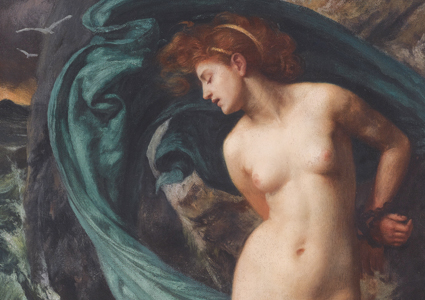
Sensuality washed away by naturalism: detail of Edward John Poynter's "Andromeda", 1869 (Studio Sebert Photographs)
What are we now to make of the Victorian aesthetes? They meant only to give pleasure; but they give the serious viewer more problems. Some visitors to A Victorian Obsession, the exhibition at Leighton House, Kensington (until March 29) of the collection of Juan Antonio Peréz Simón, look at the paintings trustingly and quietly pronounce them beautiful. They take the paintings just as they were meant—their faith must be blind. Some other visitors laugh to themselves. We too might want to laugh; but we should not sneer, for these works are full of good intentions and great efforts.
To call them "kitsch" can be a form of sneering. "Kitsch" is often a dismissive term, and, disappointed, or even offended, we tend to look away from kitsch as soon as we recognise it. Modern artists devised primitivist and brutalist tactics to get around this problem, and to make us look. But they only avoided the problem; they did not confront it. With these Victorian paintings—exemplifying just what the Modernists first recoiled from—if we now force ourselves to look, we have the opportunity to question our reactions to find out, maybe, what has gone wrong in artworks that we recognise as "kitsch".
For example, why is Edward John Poynter's Andromeda so feeble, and so preposterous? Is it any more preposterous than Titian's Andromeda in the Wallace Collection? Or is it just that its feebleness makes the preposterous conception matter more? Accidentally, the exhibition guide gives us a useful clue, noting that though Poynter was "certainly influenced by Titian", he "puts aside all the narrative elements . . . and transforms the classic nude through naturalistic touches"; thus the artist has overstated his debt to his sources, constricting his own expression; he has neglected to treat his subject-matter; and he has muddled over style, making his art incoherent. The sensuality of Andromeda, and the drama of her struggling in chains against the rocks—all of which was captured by Titian—have been washed away by Poynter's fiddly "naturalistic touches". His pedantry was typical; and pedantry is of course an obstacle to conveying drama and sensuality. Painters like Poynter were too much in love with art, both in theory and in practice. Old artworks were their idols, and their own painting practice was a tribute to those idols—art for art's sake.
Greek art served cults; it was not a cult in itself. If the bodies of Greek statues were beautiful, and their bearings noble, it was because they represented heroes and gods. The form followed the idea; the idea, and the conviction, was fundamental to that beauty. Poynter, in putting aside the narrative elements, only demonstrates how banal—and how vulgar—any form may seem as soon as the cause of its refinement has been forgotten. It is wrong to call such works "idealised"; "prettified" would be more accurate. Those hints of naturalism ultimately confirm how Poynter was not convinced by the old ideal, and they wrench Andromeda out from the glorious world of myth and right into the studio so that she becomes a naked English girl, bored, holding herself still.
Like this article? Share, save or print using the icons below:


- Time To Revisit The Two Cultures
- The Battle Against The Philistines Never Ceases
- Anything Dennett Can Do, Scruton Does Meta
- Who Will Do Justice To Our Judiciary?
- Why France Is Revolting Against The Ancien Regime
- How The EU Elite Paved The Way For Populism
- Trump's Appeal Is More Roosevelt Than Reagan
- A Letter To Our Great-Grandchildren
5:03 PM