



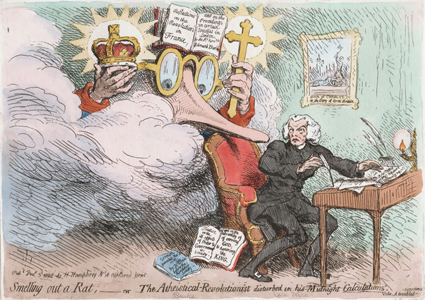
 Counter-revolutionary: “Smelling out a Rat” (1790) by James Gillray shows Burke with symbols of Church and State discovering Dr Richard Price, a radical preacher, in the act of sedition
Jesse Norman's book on Edmund Burke is a game of two unequal halves. The first is a biography, which, being composed from secondary sources, adds nothing to what we knew already about the so-called father of modern conservatism. The second is an appraisal of Burke's ideas and intellectual influence, in which Dr Norman puts his head above the parapet. His claims for Burke are considerable. "We cannot," he writes, "understand the defects of the modern world today, or modern politics, without him."
Nor is that the only grand claim made for Burke. Because of his development of the idea of party as opposed to faction in the second half of the 18th century, Burke is lauded as effectively the father not just of conservatism as we might understand the term, but of Western politics. "Truly," Dr Norman writes, "Burke can be said to be the hinge of Anglo-American, and indeed the world's, political modernity."
The author is himself a moderate, non-ideological conservative (in his spare time he is a Tory MP), and he has manifestly identified himself with Burke, or at least with his interpretation of Burke. When we haveheroes we like to build them up and assert that they have great qualities, not so much to aggrandise them as to validate our own reverence of them. So the question becomes how far Dr Norman's claims of Burke's genius and influence are legitimate, and how far the product of his own propaganda exercise.
Burke did undeniably develop the argument about the benefits of a political group becoming a party rather than a faction, and in many ways this is his crowning achievement. It justifies to an extent the author's assertion about Burke's being the key to political modernity. Once established, and for all their faults, parties became the natural way to conduct political discourse, and one wonders why nobody thought of it before. It was the natural development of an idea of faction. However, it had in the recent past come about as a natural phenomenon, after the Glorious Revolution of 1688-89 divided Whigs and Tories over those who removed King James and those who would have been happy to keep him.


- Why On Earth Should Anyone Study Philosophy?
- The Dying Days Of Zuma's South Africa
- His Master's Voice: Scruton On Wagner
- Why The Most Civilised Of Men Felt Like A Fraud
- Political Misconduct
- Cicero's Analysis Of Decline Offers Lessons For The West
- The Dead End Of Identity Politics
- Trump's Appeal Is More Roosevelt Than Reagan
11:07 PM