



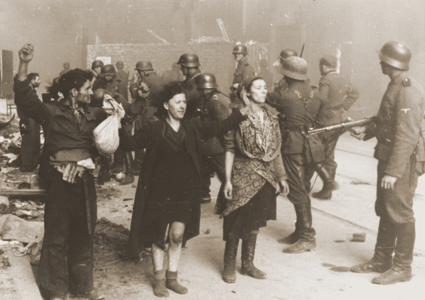
 The Warsaw Ghetto uprising, 1943: The Holocaust is less immediate to Jews of Shore’s generation
The latest book by Yale cultural historian Professor Marci Shore will fascinate some, disturb and sadden others. At times confusing and episodic, it is nonetheless gripping. The author personifies a new generation of Jewish intellectuals who reject the truths and the loyalties of their mothers and fathers. In the process of her search for meaning, she raises important issues about Central and Eastern European politics and contested interpretations of its tragic 20th-century history.
The book is a contemporary version of the story of the daughters of Tevye the Milkman, the wry hero of Fiddler on the Roof. The Yiddish writer Scholom Aleichem portrayed girls stifled by "Tradition, Tradition" in the late 19th-century stetl. (Shore is the author of a previous article titled "Tevye's Daughters: Jews and European Modernity".) The heroine of The Taste of Ashes — Shore herself — is the daughter of a Jewish doctor in rebellion against the Conservative synagogue in the small American city of Allentown, 50 miles from Philadelphia and 90 miles from New York City. She characterises herself as a "person prone by nature to feel alienated". Aged ten, she already questions the simplistic Zionist doctrines taught at Temple Beth El's Hebrew classes. It is the 1980s. She is in revolt against Ronald Reagan too. Her homegrown Jewish models are radical poets such as Allen Ginsberg.
The breach of the Berlin Wall in 1989 and the fall of the Soviet Union give her the opportunity to travel to Central Europe — especially to Czechoslovakia, to the Central European University established in Budapest by the financier George Soros, and to Poland. From her time as undergraduate student to post-doctoral researcher and then professor at Stanford, Toronto, Columbia, Indiana and Yale, she is drawn back constantly to the former Soviet satellites. What intrigues her and makes her feel more alive than in her home environment is the opportunity to meet a range of persons affected by their years under Communism. She is particularly keen to meet elderly Jewish intellectuals — "non-Jewish Jews" in her favoured mould. She immerses herself in their former world. In order to read their publications and archival correspondence, she masters an impressive series of Central European languages. In the early- and mid-20th century, Poland's leading Jewish intellectuals and poets had been left-wing rebels. She seems envious that they had been fated to live in far more tragic circumstances and at a much more dangerous time than her own. By studying and thus experiencing their lives, by mixing with their surviving children and grandchildren in Poland, she can add drama to her existence.
Now in her early forties, secure in her academic career and accepting with stated satisfaction a role as perpetual outsider, Shore has published a collage of nearly 200 fragments adapted from her notes of encounters during two decades in post-Communist countries. The literary device of the book has been deployed with success in the past, for instance in Christopher Isherwood's Berlin Stories. The publisher's blurb states that Shore's work is in the tradition of Timothy Garton Ash's The File. The formula: political turmoil in little-known countries is portrayed through the eyes of a Western observer, a young person whose personal life and development is revealed to the reader. Friends, train journeys, jazz, suicide, politics, history, religion — all are in The Taste of Ashes; but the author is driven primarily by the age-old question of Jewish identity.


- Time To Revisit The Two Cultures
- The Battle Against The Philistines Never Ceases
- Why France Is Revolting Against The Ancien Regime
- How The EU Elite Paved The Way For Populism
- Anything Dennett Can Do, Scruton Does Meta
- Trump's Appeal Is More Roosevelt Than Reagan
- Who Will Do Justice To Our Judiciary?
- Can Macron Save France — Or Is He Its Undertaker?
11:06 AM