
You are here:   Civilisation >  Critique > It's Not God Who Needs Saving - It's Us
 

The "undergraduate atheists" have had their day. The spiritually deaf onslaught of Richard Dawkins, Christopher Hitchens and their ilk has presented such an unfair and one-sided picture of religion that not only has it won few converts, but it may even have aided the cause of faith. If such crude tactics are the best the militant atheists can come up with (many open-minded readers must have thought) then perhaps religion is worth a second look after all.

Of much greater interest, and vastly more intellectual sophistication, are two books, one by the Princeton philosopher Mark Johnston, the other by the French best-selling author André Comte-Sponville, formerly of the Sorbonne. Both are inspired by the achievements of modern science, both firmly reject the traditional idea of a transcendent creator and yet both are sympathetic to our long heritage of spirituality, whose riches they would like to preserve if humanly possible.
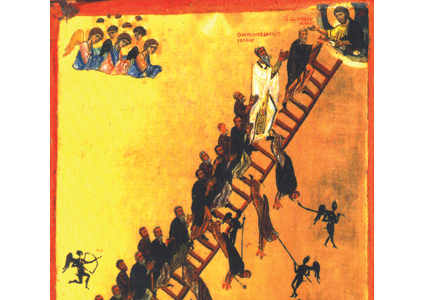
 
Upwardly mobile: The 12th-century "Heavenly Ladder of Saint John Climacus" at the Monastery of Saint Catherine, Mount Sinai, Egypt 

But can it be done? Johnston, in his intriguingly titled Saving God (Princeton University Press, 2009) insists: "The causal mechanisms that lead to life, conscious awareness, and choice can be perfectly natural, that is, in accord with the laws of nature, and they may indeed take the form of random mutation and natural selection." This is something that most theologians would now accept: why should not a divinely created cosmos develop and evolve in accordance with natural laws? But Johnston proceeds to rule out any transcendent creator by nailing his colours to the mast of ontological naturalism — the idea that there are no supernatural entities or forces and that basic science explains all there is: it provides a "causally complete model of reality". 

And now comes the distinctive twist. There is, Johnston argues, "a religious argument...that we should hope that ontological naturalism is true. For ontological naturalism would be a complete defence against...our tendency to servile idolatry and spiritual materialism." Spiritual materialism involves retaining our ordinary selfish desires (for security, comfort, success, etc) and trying to get them satisfied by manipulating supposed supernatural forces. Idolatry is similar, placating the gods to get what we want. Authentic spirituality, by contrast, must address the "large-scale structural defects in human life" — arbitrary suffering, ageing, our and our loved ones' vulnerability to time and chance and, ultimately, death. The religious or redeemed life, Johnston argues, is one where we are reconciled to these large-scale defects. 

Johnston's achievement here is to grasp the crucial difference that authentic religion makes to ethics — to the whole question of how we should live. The ordinary secular virtues (self-confidence, fairness, good judgment, etc) "take life on its own unredeemed terms and make the most of it". By contrast, the theological virtues (faith, hope, love) are "not merely intensifications of ordinary virtue, but conditions of a transformed or redeemed life". Johnston, unlike the "undergraduate atheists" (the aptly pejorative label is his own coinage), is deeply sympathetic to the resonant insights of Scripture — for example, the story of the Fall, which shows how we are by our nature caught in an oscillation between self-will and the "false righteousness" which conforms to the good out of fear or self-interest. 

View Full Article
 
Share/Save


tspoonie
September 9th, 2010
6:09 PM
"Despite all the good intentions, we end up with a worldview in which people's own self-inflated sense of what is 'worthy' of them is all the barrier that stands between us and barbarism." Well, it's either human morality or human mythology. And since I don't believe in hell, then I guess good intentions can pave the way.

D. Propson
September 9th, 2010
5:09 PM
I find it interesting that the many of the comments below assume that Mr. Cottingham is professing his view to be THE rational view. That's not the way I read him, at all. Cottingham is expressing a preference for humility, when evaluating a claim like "God exists." Encountering this claim with humility forces one to throw up one's hands, and say "I don't know." And yet, under what worldview do the things that I value -- like humility and compassion -- make sense? Certainly not a worldview that rejects a source of objective morality. Cottingham is making an argument from values to beliefs. Saying that his view is out of fashion is irrelevant, and saying that his view is "scientifically refuted" is false. What REASON does Cottingham have to reject faith?

runbei
September 9th, 2010
3:09 PM
We're on the cusp of a revolution in religion. When will the churches wake up and realize that spiritual practice needs to become scientific, if it is to regain any of the credibility it once had. Meaning - it must adopt the methods of scientific investigation. Using appropriate tools - meditation, prayer, and methods of interiorization of awareness borrowed perhaps from the East - it must conduct experiments in the laboratory of the human body. Those who have made the scientific experiment have been, in fact, the saints - not the dithering thinkers-about-religion, or the blind believers. This is a hugely important moment. We need hard evidence for religious truth. The evidence reported by the saints meets the test of science - it is uniform, repeatable, and can be directly experienced. I've found tremendous inspiration in this direction, in J. Donald Walters's excellent book, Out of the Labyrinth: For Those Who Want to Believe, But Can't. It doesn't duck the hard questions about religion that intelligent people are asking; and it provides not only intellectually cogent answers, but a method as well.

Robert Landbeck
September 9th, 2010
2:09 PM
The idea of 'religion' and God may be worth a second look, but not he existing faith paradigm. for along with fashionable atheism, theistic tradition is also now well past it's sell by date. No doubt these traditions have flavored our historical cultural development, but not its progress, which has almost always been at the expense of religious authorities. And with the modern world facing any number of virtually insurmountable conundrums, existing religion has nothing to offer but the past illusions it retails to the gullible minded. It offers nothing to serve the interests of progress, justice, freedom and the future. If there is truly a God, there must be something better then the over embellished and counterfeit theologies of men masquerading as the promise of God.

Staunch Atheist
September 9th, 2010
1:09 PM
Militant atheism? I don't recall seeing Richard Dawkins holding a gun? I do know of GW Bush holding one and targeting Muslims with it, I do know of Jews holding them targeting Palestinians with them and I know of many Christians and Muslims targeting their brothers with them. What is the reason for the term Militant Atheism when it is the God followers that use them in the name of their Lord to kill the non believers? Ignorant fools believe in God and use violence to defend their pathetic beliefs.

Mines A Newt
September 9th, 2010
7:09 AM
It's always good to note people claiming the rhetorical high ground while flinging childish insults about: "undergraduate atheists", "spiritually deaf", "crude", etc. Dawkins, supposedly crude, is quite respectful of Christianity's positive cultural contribution; but then I doubt that Cottingham has actually read Dawkins. Cottingham claims that morality comes from the god that he happens to worship. There are five problems with this: (1) there are tens of thousands of different gods, including Cottingham’s (the Christian one, called YHWH, that used to be in a Canaanite pantheon with Eli and Baal). From Amon to Zeus they all say different things about morality. Which "god-given" moral code to follow? (2) Taking the Christian god only, it endorses slavery in both the Old and New Testaments, enjoins and approves of genocide, and so on. If YHWH was real, it’d be a monster of evil. Why would any decent person follow that god's teachings? (3) If a god said humans should do something evil, would that make it good? No (as Plato pointed out a long time ago), because the moral status of an action doesn't come from whether or not it was endorsed or enjoined by a god. Even if a god really had said we should condemn people to dying of horrible diseases by banning condom use, or discriminate against homosexuals, it would still be evil to obey that god. We get our moral sense somewhere else than religion, and we always have. (4) Humans, like other primates, are gregarious, mostly peaceable creatures, though with a perverse mean streak. However, we need to live together cooperatively, and to be loved and liked. You can observe how mammals make this work. Primate social/moral rules are more complex than those of other mammals, and those of humans tend to be the most complex, and - because we can see further - to give the most moral value to altruism, cooperation and love. We do that because it helps us to live the way we want, and because cultures that don't pass these rules to their children don't thrive. Or survive. (5) We’ve outgrown religion, not just because we have better explanations of how the world works and came to be, but it’s useless as a guide to morality. Rather than revealing ethical truths, it obscures the moral sense. Take Cottingham, for example. I've a shrewd idea of what he thinks about homosexuals, unmarried couples, and so on. But consider a very basic point of morality: Is it right to kill people because they say they don't believe in your religion? Thomas Aquinas, in the Summa Theologicae, says yes: "it is right to put them to death". Cottingham cited Aquinas as an authority on morality. I expect that Cottingham would naturally, without his religion, be a decent fellow. If it wasn't for his religion, I can't imagine him approving of a writer who called for theological murder. It's Cottingham who could use some of that humility he recommends to others. It’s time he stopped flattering himself that the religion he happens to follow is a moral guide for the rest of us. He gains nothing, morally, from following a religion, and it has nothing "moral" to offer the rest of us.

JonJ
September 9th, 2010
6:09 AM
"The spiritual praxis that has enriched so much of our collective history, the practices of prayer, meditation, lectio divina and the whole structure of private and public worship, has been, in the Western tradition, inextricably linked to the Judaeo-Christian idea of our creatureliness — the notion that our very existence is shaped by a creative power, source of all goodness, truth and beauty." So for two thousand years Judaeo-Christian thought has been linked to a word you just made up? Riiiight... This is why I love to read apologetics: they are so unsullied by the ordinary constraints of logic or common sense.

S T lakshmikumar
September 9th, 2010
5:09 AM
"For one thing, it is far from clear how a worldview based on detachment and oceanic merging into the impersonal void could support anything like a morality of unconditional requirements that calls us to orient our lives towards the Good." This is nonsense as every Hindu theologian knows. The problem is more fundamental. How do you accommodate the idea that GOD is needed for morality with the fact that both sides of the American Civil War swore on the same Bible. Ultimately neither tradition nor a theology are sufficient. True neither is science. That is where the hope of the Hindu group of religions comes in. The "oceanic merging" is expected to generate in the individual the true moral response to a situation. The Christian tradition too is similar. I suggest people read "In the shoes of the Fisherman" seriously. You can pray for divine guidance but have to act with human reason. Unfortunately that is the simple reality of our existence as humans. Arrogance has no justification, religious or atheistic.

Derek Browne
September 9th, 2010
4:09 AM
The target of the 'undergraduate atheists' is not the few intellectually sophisticated, nonsupernaturalist theists, but the great majority of Christians and Moslems who accept without question a literal, uncomplicated supernaturalism.

DormantDragon
September 9th, 2010
3:09 AM
It's interesting that you speak of naturalists not being 'entitled' to use religious vocabulary. Should this be taken to mean that creationists and believers should never use scientific or naturalistic language? Surely not. Human language, like just about everything in the natural universe, evolves, and words mean different things in different contexts. Furthermore, I think it is misguided to believe that we need a transcendental entity to provide a moral impetus. Humans are social, emotive, affective animals. The consequences of our ideas and actions on life and happiness are plainly evident for those with the spiritual eyes to see. What is required for atheist spirituality is the search for truth and the creation of meaning within the context of our place in the natural universe, not the curious blend of vanity and servility to be found in religious belief.

Post your comment

CAPTCHA
This question is for testing whether you are a human visitor and to prevent automated spam submissions.