
You are here:   Civilisation >  Critique > It's Not God Who Needs Saving - It's Us
 

The "undergraduate atheists" have had their day. The spiritually deaf onslaught of Richard Dawkins, Christopher Hitchens and their ilk has presented such an unfair and one-sided picture of religion that not only has it won few converts, but it may even have aided the cause of faith. If such crude tactics are the best the militant atheists can come up with (many open-minded readers must have thought) then perhaps religion is worth a second look after all.

Of much greater interest, and vastly more intellectual sophistication, are two books, one by the Princeton philosopher Mark Johnston, the other by the French best-selling author André Comte-Sponville, formerly of the Sorbonne. Both are inspired by the achievements of modern science, both firmly reject the traditional idea of a transcendent creator and yet both are sympathetic to our long heritage of spirituality, whose riches they would like to preserve if humanly possible.
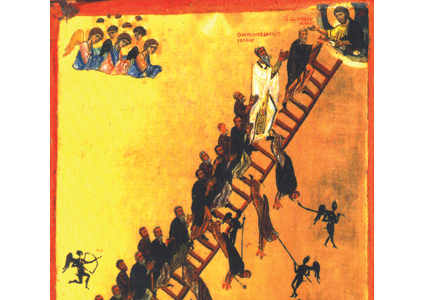
 
Upwardly mobile: The 12th-century "Heavenly Ladder of Saint John Climacus" at the Monastery of Saint Catherine, Mount Sinai, Egypt 

But can it be done? Johnston, in his intriguingly titled Saving God (Princeton University Press, 2009) insists: "The causal mechanisms that lead to life, conscious awareness, and choice can be perfectly natural, that is, in accord with the laws of nature, and they may indeed take the form of random mutation and natural selection." This is something that most theologians would now accept: why should not a divinely created cosmos develop and evolve in accordance with natural laws? But Johnston proceeds to rule out any transcendent creator by nailing his colours to the mast of ontological naturalism — the idea that there are no supernatural entities or forces and that basic science explains all there is: it provides a "causally complete model of reality". 

And now comes the distinctive twist. There is, Johnston argues, "a religious argument...that we should hope that ontological naturalism is true. For ontological naturalism would be a complete defence against...our tendency to servile idolatry and spiritual materialism." Spiritual materialism involves retaining our ordinary selfish desires (for security, comfort, success, etc) and trying to get them satisfied by manipulating supposed supernatural forces. Idolatry is similar, placating the gods to get what we want. Authentic spirituality, by contrast, must address the "large-scale structural defects in human life" — arbitrary suffering, ageing, our and our loved ones' vulnerability to time and chance and, ultimately, death. The religious or redeemed life, Johnston argues, is one where we are reconciled to these large-scale defects. 

Johnston's achievement here is to grasp the crucial difference that authentic religion makes to ethics — to the whole question of how we should live. The ordinary secular virtues (self-confidence, fairness, good judgment, etc) "take life on its own unredeemed terms and make the most of it". By contrast, the theological virtues (faith, hope, love) are "not merely intensifications of ordinary virtue, but conditions of a transformed or redeemed life". Johnston, unlike the "undergraduate atheists" (the aptly pejorative label is his own coinage), is deeply sympathetic to the resonant insights of Scripture — for example, the story of the Fall, which shows how we are by our nature caught in an oscillation between self-will and the "false righteousness" which conforms to the good out of fear or self-interest. 

View Full Article
 
Share/Save


Alan Cooper
September 9th, 2010
2:09 AM
Of course "we cannot create our own values", but neither of the authors reviewed is claiming that we can. We inherit our values through a combination of genes and culture, and religion *may* provide a useful metaphor for thinking and communicating about them.

John
September 9th, 2010
1:09 AM
Mr. Cottingham begs the question: If no God exists then it follows that humans were still able to develop this nuanced spiritual tradition around the mere idea of God. It may be Mr. Cottingham's position that we need to save the mere "idea of God" in order to have a deeper spiritual tradition. Or then again, it may be Mr. Cottingham's position that only a real God can catalyze such a tradition into existence. Either way, it's a bit strange that in his rebuttal of the atheists, Mr. Cottingham does not clearly make an ontological claim to the contrary - but appears merely to express an anthropological concern about the dangers of not going beyond anthropology.

Jon M
September 8th, 2010
11:09 PM
Heartily agreed! Except that I won't concede that these authors have 'considerable gifts'. Considerable Gifts are precisely what ought to have prevented these Considerable Errors. What a pity that "authentic religion" cannot also be self-conscious of the good reasons to believe that it is false, and that irony cannot be reclassified as faith... otherwise, Johnston's arguments might actually make sense. The wrongness here is not hidden: it jumps out at you. This is really appalling stuff from the point of view of reason. We should embrace religious spiritualism because it is functional? Because belief has a natural basis? In case it had gone unnoticed: practical minded clergy have been using this approach for many years. Therapy by any other name is still bul...

Erik
September 8th, 2010
9:09 PM
It prattle of this sort that helps confirm my atheism.

kibitzer
September 8th, 2010
8:09 PM
Religion is not the basis of ethics, ethics precedes religion. Ethics derive initially from family emotional ties and the bonds of trust between members of hunting groups. It has biological roots. Religion adopted these and added on religious based ethics such as the need for human sacrifice (aztec religion, celtic religion) the need for holy war (islam, christianity) killing for minor taboo infringments (pacific religions) and every other horrible act possible to imagine.

jackie hayden
September 8th, 2010
6:09 PM
Arguments about the creation of the world, by whatever or whomever means, make one enormous assumption-that the world was created. It is equally possible, and equally unproveable, that the world has always existed.

Anonymous
September 8th, 2010
6:09 PM
There seems to be an unwillingness in this review to truly consider the notion of spirituality without the belief in an external higher power. I fail to be convinced by your argument that there can be nothing holy about the natural process. My interpretation of your quotes from Johnston is that the physical is holy simply because it is. That is to say, rather than attribute the word "god" to an undetermined creator, and worshiping him/her/it in an (insert theistic religion here) fashion; we could attach the word "god" to the earth, the stars, ourselves. This is in agreement with the scientific understanding that when broken down to their fundamental elements, everything is made of the same stuff (string theory and all that). This understanding of "god" is not contradictory to naturalism as there is no assumption of a supernatural force. More importantly, this entails a different relationship with "god", in which, rather than worshiping "god" as a separate entity, one understands that he/she is a part of "god", as is everyone and everything else. Thus spirituality still retains its objective of being connected with "god", however, our understanding of "god" becomes a different one. I disagree with your counter argument that the natural process cannot be holy as it is understood as nothing more than the natural process. That statement suggests that your definition of spirituality is that of "god" as a separate entity, and that you are unwilling to consider this other interpretation of god to be "true" spirituality. You're thus basing your argument on a personal assumption, one which I do not share. Perhaps if you took the time to define what you meant by spirituality, I might have convinced. Instead, your appeal to spirituality and the "legacy of spirituality", which you base many of your arguments upon, is meaningless. I imagine theistic readers who share the same definition of spirituality that you imply, would be feverishly nodding their heads in agreement with your review, however, I don't necessarily agree with that definition, and your argument therefore feels a little holy (that's right, I ended that with a pun!)

John Lauritsen
September 8th, 2010
6:09 PM
Cottingham states: "much of the resonance of the Judaeo-Christian worldview lies in its luminous moral insights." Really? Such luminous moral precepts as stoning to death males who have sex with each other? What is luminously moral about taboos on eating the wrong kind of food or wearing the wrong kind of clothing? (Holiness Code of Leviticus) Or about Yahweh commanding his people to massacre gentiles -- men, women and children -- and even to kill the animals of gentiles? Waging war against the higher culture of Classical Antiquity, leading to the Dark Ages? Burning heretics, witches and sodomites at the stake? Who needs such "luminous moral insights", or for that matter "spirituality", which seems to be a euphemism for superstition or general muddle-headedness.

Greg
September 8th, 2010
5:09 PM
"We need, as Comte-Sponville rightly concedes, fidelity to the tradition that shaped us." The tradition that shaped us consisted mostly of killing other animals to survive. Why should that enforce a moral obligation on us? That the writer does not have a better suggestion for conserving the morality he is comfortable with is a poor reason for basing our morality on what was. And even needing something to be true does not make it so.

Anonymous
September 8th, 2010
5:09 PM
The analysis is decent, the conclusion trite.

Post your comment

CAPTCHA
This question is for testing whether you are a human visitor and to prevent automated spam submissions.