


The "undergraduate atheists" have had their day. The spiritually deaf onslaught of Richard Dawkins, Christopher Hitchens and their ilk has presented such an unfair and one-sided picture of religion that not only has it won few converts, but it may even have aided the cause of faith. If such crude tactics are the best the militant atheists can come up with (many open-minded readers must have thought) then perhaps religion is worth a second look after all.
Of much greater interest, and vastly more intellectual sophistication, are two books, one by the Princeton philosopher Mark Johnston, the other by the French best-selling author André Comte-Sponville, formerly of the Sorbonne. Both are inspired by the achievements of modern science, both firmly reject the traditional idea of a transcendent creator and yet both are sympathetic to our long heritage of spirituality, whose riches they would like to preserve if humanly possible.
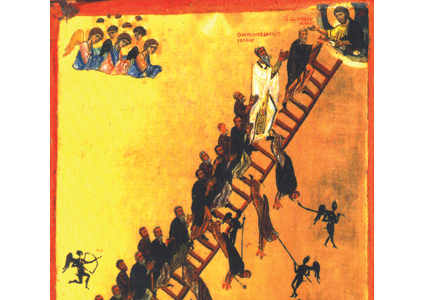
Upwardly mobile: The 12th-century "Heavenly Ladder of Saint John Climacus" at the Monastery of Saint Catherine, Mount Sinai, Egypt
But can it be done? Johnston, in his intriguingly titled Saving God (Princeton University Press, 2009) insists: "The causal mechanisms that lead to life, conscious awareness, and choice can be perfectly natural, that is, in accord with the laws of nature, and they may indeed take the form of random mutation and natural selection." This is something that most theologians would now accept: why should not a divinely created cosmos develop and evolve in accordance with natural laws? But Johnston proceeds to rule out any transcendent creator by nailing his colours to the mast of ontological naturalism — the idea that there are no supernatural entities or forces and that basic science explains all there is: it provides a "causally complete model of reality".
And now comes the distinctive twist. There is, Johnston argues, "a religious argument...that we should hope that ontological naturalism is true. For ontological naturalism would be a complete defence against...our tendency to servile idolatry and spiritual materialism." Spiritual materialism involves retaining our ordinary selfish desires (for security, comfort, success, etc) and trying to get them satisfied by manipulating supposed supernatural forces. Idolatry is similar, placating the gods to get what we want. Authentic spirituality, by contrast, must address the "large-scale structural defects in human life" — arbitrary suffering, ageing, our and our loved ones' vulnerability to time and chance and, ultimately, death. The religious or redeemed life, Johnston argues, is one where we are reconciled to these large-scale defects.
Johnston's achievement here is to grasp the crucial difference that authentic religion makes to ethics — to the whole question of how we should live. The ordinary secular virtues (self-confidence, fairness, good judgment, etc) "take life on its own unredeemed terms and make the most of it". By contrast, the theological virtues (faith, hope, love) are "not merely intensifications of ordinary virtue, but conditions of a transformed or redeemed life". Johnston, unlike the "undergraduate atheists" (the aptly pejorative label is his own coinage), is deeply sympathetic to the resonant insights of Scripture — for example, the story of the Fall, which shows how we are by our nature caught in an oscillation between self-will and the "false righteousness" which conforms to the good out of fear or self-interest.


5:09 PM
5:09 PM
4:09 PM
3:09 PM
2:09 PM
2:09 PM
1:09 PM