


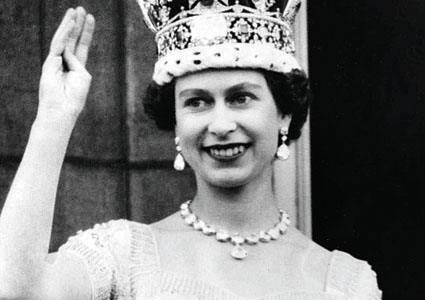
 Long to reign over us: Queen Elizabeth II waves from the palace balcony after her coronation in 1953 (National Media Museum/ The Commons)
From our earliest years, we delight in hearing about kings and queens, princes and princesses, without needing to know why we are drawn to these stories. The first reason to tell our children the history of our kings and queens is for pleasure. As J.H. Plumb remarks in his book on the first four Georges, “It is almost impossible for a monarch to be dull, no matter how stupid.” Here human passions, admirable and disgraceful, are played out for the highest stakes. No wonder Shakespeare wrote play after play about royalty and rebellion, ranging from ancient times to the still quite recent convulsions on the English throne.
From 1307 to 1485, England had nine kings, of whom four were murdered and one died in battle, while the other four died of illness, but fought battles in which they too might have perished. Even today, Henry V expresses English patriotism in its most cheerful form, as a perfect mixture of elitism and egalitarianism: “We few, we happy few, we band of brothers.”
These things are uppermost in my mind because I have just attempted, in a volume of brief lives of all 40 monarchs from William the Conqueror to the present Queen (Gimson’s Kings and Queens, Square Peg, £10.99), to tell the story for enjoyment rather than edification. I like knowing which monarch was known as “Dismal Jimmy”; which was probably the first to eat ice cream; which one locked up his wife for 32 years after hearing she was about to elope with a Swede; who told his valet, as the royal yacht approached the coast of Scotland, “Un costume un peu plus écossais demain”; and which heir to the throne inquired, when conversation flagged during lunch with a famous novelist: “Now you can settle this, Mr Hardy. I was having an argument with my Mama the other day. She said you had once written a book called Tess of the d’Urbervilles, and I said I was sure it was by somebody else.”*
But while drawing a picture of each of our monarchs, I couldn’t help wondering why they still have such a hold on our imagination. This is not a narrowly British point, or one which applies only to children. Go to some distant part of the globe, and you are far more likely to be asked about our Queen (who will be 90 in May) than our Prime Minister.
Yet with the exception of Bagehot (usefully derided by Ferdinand Mount in The British Constitution Now) not much has been written in the last 200 years which casts light on the attraction of kingship. Among political writers, the rise of democracy has tended to eclipse everything else. In a way this is right and proper, for here is the great new force which lends legitimacy to government. Our political system is acceptable because at a general election we can sack whichever set of rogues has been running the show, and can put in the other lot. Here is the most popular and indispensable check on the abuse of power, and I would not wish anything in the rest of this article to be taken as implying any kind of opposition to it.
Like this article? Share, save or print using the icons below:


More Features
- The Coalition We Need To Defeat Islamism
- Are We Losing The War On Home-Grown Terror?
- Cameron Gave Libyans A Chance. Pity They Blew It
- Brexit Will Give Global Free Trade A Boost
- The Real EU Referendum Winner May Surprise You
- Is Theresa May The True Heir To Mrs Thatcher?
- Race To The White House Through The Looking-Glass
- Brexit Gives Us A Historic Opportunity
- American Conservatives Must Stand Up To Trump
- Cicero's Analysis Of Decline Offers Lessons For The West
- Deepdene: Rise and Fall of the House of Hope
- Debunking the EU Referendum Myths
- Britain's Opportunity Is Europe's Warning
- Controlling Immigration Is Good For Democracy
- The Pied Piper of Islington
- The West Cannot Afford To Ditch Nato
- End Of History — Or Clash Of Civilisations?
- We Can Defeat Islamist Terror — But Not On Our Own
- Without the Emperor, What is Left of Old Japan?
- Now Or Never
Popular Standpoint topics

- Islam and the French Republic
- Rediscovering Our Moral Purpose
- Why On Earth Should Anyone Study Philosophy?
- Making Up For Lost Time
- His Master's Voice: Scruton On Wagner
- The Dying Days Of Zuma's South Africa
- Why The Most Civilised Of Men Felt Like A Fraud
- Cicero's Analysis Of Decline Offers Lessons For The West
4:01 AM
5:01 PM
5:12 AM
9:12 AM
3:12 PM