


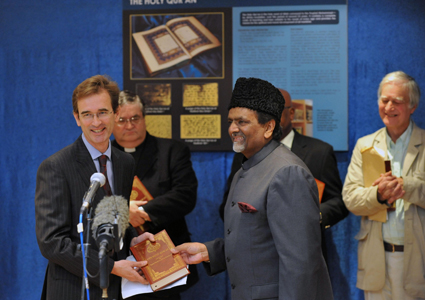
 “We like it here, everyone is free”: Rafiq Hayat (right), with Philip Breeden, Press Counsellor at the US Embassy, London
As Friday prayers end thousands of believers stream out of the mosque. Keen-eyed men with Pashtun cheekbones hover by a convoy of cars, many of them wearing the traditional hats of Pakistan's North-West Frontier province. Were it not for the Tube depot in the background, one could be in that exotic land with its long and sometimes unhappy links with Britain. Departing last, and driven safely away, is Hadhrat Mizra Masroor Ahmad, the fifth leader of the worldwide Ahmadiyya community.
Built on the site of a former dairy in 2003, the Baitul Futuh in Morden, south London, is the largest mosque in western Europe, with capacity for 10,000 people. When I first visit, around 6,000 believers are packed into the complex, bowed in prayer. There is an airport-style X-ray machine by the entrances, something churchgoers might find alarming, although the Baitul Futuh looks lightly protected compared to the Ahmadiyya mosque in nearby Putney.
There was some local hostility when the mosque opened. Religious centres are rarely welcomed by any community, bringing as they do not just traffic and noise but inevitably more believers to the area, and in a neighbourhood inhabited by many people who fled inner London a generation ago there was bound to be difficulty. Yet the Ahmadiyya are nothing if not good neighbours. The mosque's conference hall is used by various local civic bodies, and every year chocolate is handed out to local people at Eid, a small gesture that nonetheless warms relations. Besides which, the security is not to protect them from BNP supporters.
Ahmadiyya is an Islamic reformist movement that began more than a century ago in British India. Little known outside Pakistan, where half of its ten million followers live, it has nonetheless attracted some attention in Britain for its now annual poppy-selling drive, which raises more than £20,000 a year for the British Legion.
The Ahmadi follow Mirza Ghulam Ahmad, born in the Punjab in 1835, who in 1889 declared himself to be the promised messiah (Imam Mahdi). After his death in 1908 his followers split, with some taking the orthodox Sunni view that there could be no more prophets, and the others, the Ahmadiyya, becoming a new sect. Born on the crossroads of the world's Western and Eastern faiths, they also see Krishna and Buddha as prophets, and this varied religious palate perhaps explains their instinctive tolerance.


- Admit It, Mr Kerry: You Blundered
- Bismarck Versus Blair — A Foreign Policy Crossroads
- Arab Spring, Islamist Summer — What Next?
- The Diplomat the Whole World Ignores
- The Blob Has Run Schools For Decades. Not Any More
- Would You Intervene — Or Pass On The Other Side?
- He Died That Others Might Live In Peace
- The Hero's Journey is Hollywood's McMyth
- Online Only: Countering the Counter-Jihadists
- Online Only: The Price Paid for Criticising Islam
- 'Please Sir, I Just Want to Learn More'
- Why Students Should Be Glad To Pay Tuition Fees
- A 'Liberal Racist'? Me? I Felt Like a Heretic
- Demolish the Relics of Yesterday's Future
- Was Britain Right To Go To War In 1914?
- German Victorians Who Helped Transform Britain
- The Alternative History of an Undivided India
- Online Only: Heirs to the Left
- ONLINE ONLY: The Hayward Gallery's Fashionable Primitives
- ONLINE ONLY: A Spiritual Corner of Southwark

- The Zombie Argument that Refuses to Die
- Online Only: The Price Paid for Criticising Islam
- Overrated: Dan Brown
- Is the Brain the Key to Understanding Religion?
- Overrated: George Monbiot
- Time to Wise Up to the Muslim Brotherhood
- 'Please Sir, I Just Want to Learn More'
- The Alternative History of an Undivided India
- The Zombie Argument that Refuses to Die
- Online Only: The Price Paid for Criticising Islam
- Overrated: Dan Brown
- Is the Brain the Key to Understanding Religion?
- Overrated: George Monbiot
- Time to Wise Up to the Muslim Brotherhood
- 'Please Sir, I Just Want to Learn More'
- The Alternative History of an Undivided India
- Decline and Fall of the History Men
- Uncritical Theorists Who Misread the Nazis
- The Zombie Argument that Refuses to Die
- The Banality of Hannah Arendt
- From Kitsch to Cool: Picasso and Modern Art
- Is the Brain the Key to Understanding Religion?
- Time to Wise Up to the Muslim Brotherhood
- Midfield Virtuoso Finds His Perfect Pitch
- Online Only: The Price Paid for Criticising Islam
- Overrated: George Monbiot
- Letter from Ukraine: Reviving Lost Literature
- Tsar Of The Holy Land
- On Pilgrimage with the Hasids
- The Blob Has Run Schools For Decades. Not Any More
- My Dieting Guide: Listen To Mother
- Bismarck Versus Blair — A Foreign Policy Crossroads
11:06 PM
2:05 PM
8:05 PM
5:05 AM