


Walsingham in north Norfolk has, architectural historians report, one of the finest extant medieval high streets in Britain. The merchant houses are packed tightly together, some with first floors that overhang the pavement, others half-timbered with leaded windows, many Grade One listed, most restored but a dwindling bunch in a sad state of neglect.
The story of this time-capsule of a village, buried deep in the lanes of the Norfolk countryside, hinges on a single year — 1537. This was when Henry VIII ordered the dissolution of the monasteries following his break with the Pope in Rome. Before that date, for almost 500 years since the Virgin Mary was believed to have appeared there to a local noble woman, Richeldis de Faverche, Walsingham had been one of the greatest Marian shrines in Europe, those historic merchant houses the fruit of the trade generated by pilgrims who walked, often barefoot, along a route that stretched back first to Ely and then London. Every English king from Edward I had prayed there, including Henry VIII himself who came in 1519 to give thanks to Our Lady of Walsingham for the birth of a short-lived son.
And after that date? Well, time effectively stood still. With the abbey and its vast priory church reduced to rubble by royal command, there were no more pilgrims and no more trade, and the high street had only the local farming community to serve. Most of the buildings were mothballed or left to rot. It was only in the 20th century that a modest revival began, with the re-establishment of first a Catholic shrine and then an Anglican one (their separateness is a lingering scar of the Reformation).
Overall, though, little has changed in Walsingham in half a millennium. Walking up its high street, from the roughly triangular Friday Market at the foot of the village to Common Ground, the-not-quite-square at its centre, it takes little effort to imagine myself back in pre-Reformation times. But what, I find myself wondering, would the rest of England look like now if it had remained Catholic?
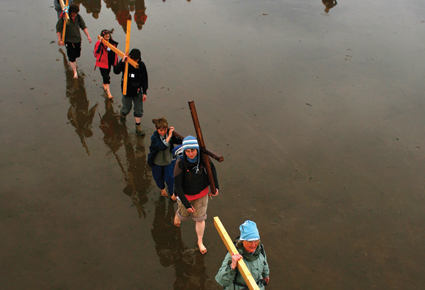
Catholic camaraderie: Pilgrims across the mud slakes to Lindisfarne (Getty Images)
It seems I am not the only one asking the question. Last month, more than 700 people gathered in London's Royal Geographical Society to debate the motion "England Should Be a Catholic Country Again". It was, said the Spectator which had organised the event as part of a rolling series, the biggest crowd it had attracted so far. Remarkably, the proposers — headed by a genial but effective Cardinal Cormac Murphy-O'Connor — carried the day. Granted, this one result hardly counts as evidence of a major shift in religious sentiment in our officially Anglican but largely secular and sceptical society, but it is arguably a sign that something may be stirring in our
national soul.


- The Coalition We Need To Defeat Islamism
- Are We Losing The War On Home-Grown Terror?
- Cameron Gave Libyans A Chance. Pity They Blew It
- Brexit Will Give Global Free Trade A Boost
- The Real EU Referendum Winner May Surprise You
- Is Theresa May The True Heir To Mrs Thatcher?
- Race To The White House Through The Looking-Glass
- Brexit Gives Us A Historic Opportunity
- American Conservatives Must Stand Up To Trump
- Cicero's Analysis Of Decline Offers Lessons For The West
- Deepdene: Rise and Fall of the House of Hope
- Debunking the EU Referendum Myths
- Britain's Opportunity Is Europe's Warning
- Controlling Immigration Is Good For Democracy
- The Pied Piper of Islington
- The West Cannot Afford To Ditch Nato
- End Of History — Or Clash Of Civilisations?
- We Can Defeat Islamist Terror — But Not On Our Own
- Without the Emperor, What is Left of Old Japan?
- Now Or Never

1:05 PM
4:04 AM
8:04 AM
8:04 AM
4:04 PM
10:04 AM