



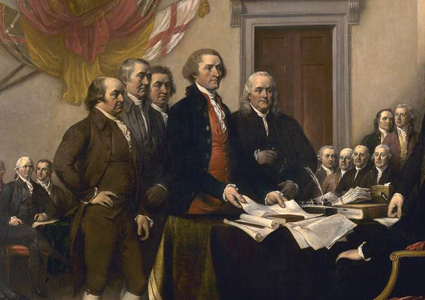
America can still rejuvenate itself: Some of the visionary founding fathers of the US depicted by John Turnbull in a detail from "The Declaration of Independence"
How often do we hear the word "decline" applied to America, Europe and the West? The rhetoric of decline has become a staple of our public discourse, so much so that most hardly notice when it crosses the line from rationality to fantasy. The distinction is important and easy enough to apply. If a commentator claims that "Europe is in demographic decline", he is making a statement about a statistical fact — birthrates across much of the European continent have indeed been falling for many years — which can be quantified, verified and tested. If, on the other hand, a commentator claims that "America's decline is inevitable", he is making a whole series of assumptions that are based, not on facts, but on what I call the mythology of decline. I want to examine the origins and purposes of that mythology in order to help us to distinguish the legitimate use of the term "decline" from the mythological one, which invariably serves an ideological agenda — what we may call declinism. And if my analysis serves to clear the somewhat fetid atmosphere that pervades this debate, in which self-fulfilling prophecies of American decline abound — if I can hasten the decline of declinism, in other words — then that is a job worth doing.
Let us begin with Gibbon. Had the author of The History of the Decline and Fall of the Roman Empire not written such consummate prose, had he not dared to laugh the sacred to scorn and elevate the profane to respectability, perhaps his unwieldy work would not have enjoyed classical status almost from the day of publication of the first volume. We have been meditating on the possibility of our own decline and fall ever since. If Gibbon saw in Rome a parable of the perils of religious enthusiasm — the church having first undermined, then supplanted the state — his intellectual posterity extended his paradigm to create a romantic cult of decline.
It was as natural that the Enlightenment should view imperial decline as a consequence of irrationalism as that the Romantics should blame rationalism for the same phenomenon. As the 19th century wore on, thinkers seized on novel forces they saw emerging in their own day to explain decline: Malthus identified demography, Tocqueville democracy, Buckle climatology, Marx capitalism, Gobineau race, Nordau urbanisation. Everybody had a different terminus post quem, or starting point for decline: Newman dated it from the Reformation, Kierkegaard from the early Church, Nietzsche from ancient Greece, Bachofen from the end of matriarchy, Freud from the dawn of civilisation. In this age of progress and optimism, decline was actually ubiquitous. In biology, Darwin had described the descent of man from the primeval slime, in physics Clausius and Kelvin had described the irreversible entropy of the universe in the second law of thermodynamics, and in metaphysics Schopenhauer had described life as "a business that does not cover its costs".


- The Fate Of The West
- Monks, Magi and Mosques: Religion on the Silk Road
- The Rest Is Silence
- The Sacred And The Secular In Contemporary Art
- Siege
- Regulating Markets In An Economy Without Angels
- Birth Mother
- Europe and the Nation State: Thoughts on Ortega y Gasset
- Seven New Poems
- Rediscovering Our Moral Purpose
- Our Strength And Stay
- Three Poems By Heinrich Heine
- Two Poems From Spain
- Why Only Countries Willing To Take Risks Will Survive And Prosper
- From The Berlin Wall To Brexit: Why Politics Needs A Free Press
- Saying Yes To Sara
- The Viagra Triangle
- Two Languages And The Chasm Between Them
- Western Civilisation In Crisis
- The Man On Whom Everything Was Lost

- Opposites meet in the land of Scrugletopia
- The Battle Against The Philistines Never Ceases
- Anything Dennett Can Do, Scruton Does Meta
- Home from home for the Bolshevik elite
- How The EU Elite Paved The Way For Populism
- Why France Is Revolting Against The Ancien Regime
- Can Macron Save France — Or Is He Its Undertaker?
- Last Of The Great Elitists
3:02 PM
11:11 PM
10:11 AM
5:11 PM