


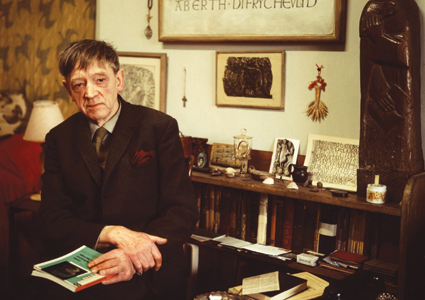
 David Jones, photographed at home by Mark Gerson, 1965
Blundering in the darkness of no man's land some minutes after midnight on July 10, 1916, Private David Jones felt his legs knocked from under him. Shot through the calf by a German rifle bullet, his left boot filling with blood, he sank to his knees on the dry earth of Mametz Wood.
Crawling along the ground, the sky lit by flashes of shellfire, he made his way past the corpses of the men of his battalion, waiting for the stretcher bearers to find him. Later, as he boarded the hospital ship St David, which would take him back to England, a fair-haired Canadian nurse bent over and, kissing his face, said: "You ought to be in kindergarten." He ought not to have been there at all.
When war broke out in August 1914, David Walter Jones was a pale, undersized, moon-faced boy of 19, recently graduated from Camberwell College of Art with a portfolio of sketches and a notebook of unpublished poems.
He was sensitive, bookish and shy, with a romantic's interest in the past: The Canterbury Tales, the Anglo-Saxon Chronicle, the Norse sagas, the Arthurian legends. A printmaker-poet, the unlikeliest of warriors.
If Jones had wondered in the summer of 1914 how he might make a living as an artist, the war offered an answer of sorts. With his mind full of chivalric knights and cavalry charges, he sought admission to the Artists' Rifles, a London regiment. The doctor who examined Jones briskly dismissed all romantic notions. His chest measurement was declared "deficient" and Jones was sent back to his watercolour portfolio and his parents' house in Brockley.
By the New Year, however, heavy losses in France had forced the relaxation of physical requirements and so on January 2, 1915, the pigeon-chested Private Jones enlisted in the London Welsh Battalion. Over the next three years, this hapless art student, "grotesquely incompetent, a knocker-over of piles, a parade's despair", would be transformed into a battle-hardened Tommy, a veteran of the trenches.
His experiences of the Western Front, and particularly of the Somme and the struggle for Mametz Wood, would scar him for the rest of his life and inspire the greatest epic poem of that conflict: In Parenthesis.


Post your comment
- Granby Four Streets
- Ben Uri At 100
- Godfrey MacDomnic
- Ushaw College
- Peter Schmersal
- Mark Boxer
- Carol Robertson
- Drawing Board: Sarah Butterfield
- Drawing Board: Egon Schiele
- Drawing Board: New York Mid-Century
- The Schorr Collection
- The Lod Mosaic
- Disparaged masters of the late Renaissance
- The Arrival of Spring
- Henry Tonks: A Strange New Art
- A Roman Pilgrimage
- Back to the Drawing Board with Andrew Marr
- Giovanni Benedetto Castiglione
- Honoré Daumier
- Sir Hugh Casson
