



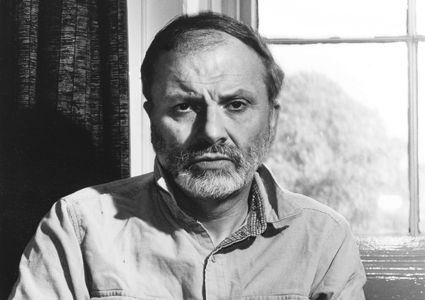
Laureate of language: Geoffrey Hill, photographed by Christopher Barker for his book "Portraits of Poets" in 1986
It was drizzling and already dusk when I arrived at the Examination Schools in Oxford one afternoon in March to hear Sir Geoffrey Hill lecture on poetry. Entering that forbidding Victorian pile, mounting the long staircase and arriving in the South School triggered a buried, decades-old recollection of the agonies of Finals. More than 60 years ago, my mother had also sat Finals here, alongside Geoffrey Hill; they were both reading English and might have attended the same lectures by (among others) C.S. Lewis and J.R.R. Tolkien. A little later, in London, they might have been to the same readings by such luminaries of the day as T.S. Eliot and Dylan Thomas. But they never met. My daughter, now also reading English and about to sit Finals in her turn, was waiting for me, having saved me a seat.
Inside that unprepossessing auditorium, presided over by a portrait of Kaiser Bill in academic scarlet, the lecture had just begun. There, silver-bearded and sonorous-voiced, was the Professor of Poetry. Already he held the large audience under his spell; apart from the occasional ripple of laughter at his sallies against his fellow poets, respect bordering on reverence prevailed. It could have been — perhaps it was — the Ancient of Days. Now in his early eighties, Geoffrey Hill has all the gravitas that attaches to his chair, but remains quixotic, impish and irreverent. His purpose in giving these lectures was evidently not to flatter his audience of dons, undergraduates and interlopers like me, but to do what he could to provoke us.
As I entered, the Professor of Poetry was reciting: not verses, but extracts from Lincoln's Gettysburg Address and Martin Luther King's "I have a dream" speech. He went on to explain that his theme was "Monumentality and Bidding" — terms of art taken from one of his heroes of prosody, Gerard Manley Hopkins — and that his argument was that enduring, not to say great, poetry and prose must combine these two qualities. Monumentality speaks for itself, but by "bidding" Hopkins meant speaking directly to the reader and keeping his attention, "making it everywhere an act of intercourse" — "social intercourse", Hill interjected with a wry smile. (I suspect Hopkins the Jesuit also had in mind the sense of supplication, as in the "bidding prayers" offered up to God in every Mass.) The great speeches of Lincoln and King, a sonnet by Hopkins, the music of Purcell: each was analysed minutely, with frequent reference to the Oxford English Dictionary. It was all of a piece and, in its endearingly idiosyncratic way, "Hillian".
Last month, I returned to Oxford for another dose, drawn irresistibly by the magnetism of this voice versifying in the wilderness. There is no denying that his lectures, like his poems, are difficult — but they are not so for the sake of exclusiveness. Hill addressed himself on this occasion to "any reader of intelligent goodwill" and in a line from one of his Expostulations on the Volcano, he insists: "I do not establish the recondite as Hill-school."
This entire May lecture was dedicated to resolving a single question in a single poem, "The Windhover" by Gerard Manley Hopkins: to whom was his vivid evocation of the "lyric flight" of the bird addressed? Was "thee" the bird or the poem's dedicatee, Jesus Christ? (Long after writing it, the poet added the title "To Christ our Lord", but there is no obvious solution.) In the hour spent answering this question, Hill offered a defence not only of poet and poem, but also of the "earnestness of spirit" — saturated in Classical culture and Catholic theology — that had made it possible for Hopkins to "find his way right at last to the true functions of his mind" and in doing so to create the new prosody of sprung rhythm. The very artificiality of such an "abrupt metre" creates naturalness, Hill argued, with a characteristic sideswipe at contemporary poets: "If only that were better understood at the present time."
Like this article? Share, save or print using the icons below:


More Features
- Can Macron Save France — Or Is He Its Undertaker?
- Europe's Revival Is At Hand, Thanks To Brexit
- Is This The Most Important British General Election Since 1979?
- The New Europe Must Be About More Than Money
- Our Best Brexit Policy Is All-Out Free Trade
- The Bursting Of Our 'Kabubble' Fantasies
- Gambling On A Greater More Gracious Britain
- Xi Versus Trump: The Emperor And The Tycoon
- Can Trump Square The Circle On Fiscal Reform?
- Donald Trump And The Dividing Of America
- Theresa May Emerges From Thatcher's Shadow
- Not Tweets And Anger But Redoubled Vigilance
- Why France Is Revolting Against The Ancien Regime
- How The EU Elite Paved The Way For Populism
- Trump's America: The End Of Exceptionalism
- The Kaliningrad Contingency
- Mrs May Is Too Canny To Say Farewell To Arms
- To Understand Trump, Read Huxley — Not Orwell
- A Letter To Our Great-Grandchildren
- Trump Is No Loser, But Government Will Be Harder
Popular Standpoint topics

- Time To Revisit The Two Cultures
- The Battle Against The Philistines Never Ceases
- Who Will Do Justice To Our Judiciary?
- How The EU Elite Paved The Way For Populism
- Trump's Appeal Is More Roosevelt Than Reagan
- Anything Dennett Can Do, Scruton Does Meta
- Why France Is Revolting Against The Ancien Regime
- A Letter To Our Great-Grandchildren
8:06 PM
1:06 AM
10:06 AM
5:05 PM