



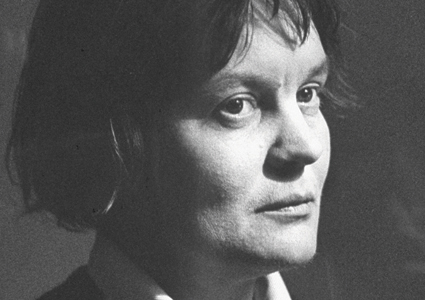
 Novelist and tutor, 1960: As a student, Iris Murdoch had confided to a friend: “I find myself quite astonishingly interested in the opposite sex” (photo: ©Horst Tappe/Pic Inc/Life Images Collection/Getty)
There are various ways to lead a life, but the most difficult form of life to write about is that of the mind, the intellectual life. The journey into a rich and profound interior existence, though arduous, is also the most rewarding for the writer, for it promises to reveal the buried treasure of imagination and ideas that give such a life its lustre. Leading the intellectual life is not the same as being an intellectual — not, at least, in the self-conscious, usually self-aggrandising sense of the word — but instead refers to an activity. The vita contemplativa is in reality a form of the vita activa, only all the action takes place in the mind. And it is this abstract species of action — the drama of interiority — that holds an all-consuming interest for a certain kind of novelist. The interest is proportionate to the intensity of the intellectual life in question. What is known in English as the novel of ideas, which originally derives from the German genre of the Bildungsroman, is the literary expression of the emergence of an intellectual life. It is here that the domains of the philosopher and the novelist overlap, nowhere more clearly than in the work of a woman whose intellectual life embraced both vocations with equal enthusiasm: Iris Murdoch (1919-1999).
By the time I made her acquaintance in the 1980s, Iris had been a public figure for a generation. Her only rival as a philosopher-novelist had been Sartre, whom she had introduced to the Anglo-Saxon world. Having outlived and in many ways outshone him, she was a star of the first magnitude in the intellectual constellation of post-war Europe. Though she belonged to a brilliant generation of female philosophers — her “dearest girl” Philippa (“Pip”) Foot, her “friend-foe” Elizabeth Anscombe, and her friends Mary Midgley and Mary Warnock — all of whom made major contributions to academic and public life, Iris was the only philosopher of either sex among her contemporaries to become a truly national figure. She deserved her renown; her posthumous reputation as a writer and thinker has survived the scrutiny of biographers and critics. She never wrote an autobiography, but her letters reveal her introspective side, as she looks back over la vie antérieure and forward to new fields — and men — to conquer.
I became aware of her name already in childhood; my mother reviewed the novels as they appeared for the TLS. One of my early memories at Oxford was failing to gain admittance to the Sheldonian Theatre to hear Iris deliver her 1976 Romanes Lecture (“The Fire and the Sun: Why Plato banished the artists”). The university was belatedly honouring one of its most celebrated dons, but her sphere of influence had never been confined to Oxford. Uniquely endowed with both analytical and synthetic talents, Iris Murdoch had effortlessly conquered both literary and academic worlds. Even queens of the cultural realm like Hannah Arendt or Susan Sontag could not claim to have produced a corpus of such breadth and depth: some 26 novels, plus poetry and plays, together with several volumes of philosophy, ranging from East to West and ancient to modern.
Like this article? Share, save or print using the icons below:


- Time To Revisit The Two Cultures
- The Battle Against The Philistines Never Ceases
- Who Will Do Justice To Our Judiciary?
- How The EU Elite Paved The Way For Populism
- Trump's Appeal Is More Roosevelt Than Reagan
- Anything Dennett Can Do, Scruton Does Meta
- Why France Is Revolting Against The Ancien Regime
- A Letter To Our Great-Grandchildren
9:11 AM
6:11 AM
3:11 AM
8:10 PM