


At its most basic, this election pits a Prime Minister and her party committed to taking Britain out of the European Union and establishing our country as an independent nation against an informal alliance of forces regretful or resentful about that new course.
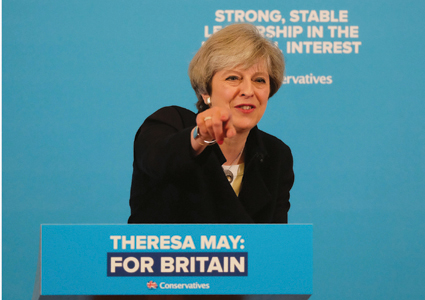 A Burkean with a vision of global Britain: Theresa May hits the campaign trail on Tyneside last month (©Ian Forsyth/Getty Images)
Within the ranks of those who were the Parliamentary Labour Party there is scarcely any enthusiasm for the restoration of British independence; indeed, there is a powerful faction allied to former leaders such as Tony Blair and Peter Mandelson which wishes actively to dilute or frustrate the referendum result. Occupying a similar space, the Liberal Democrats have pitched themselves as an unambiguously pro-EU force, seeking a mandate to get the country to think, and vote, again on exit. The various secessionist parties who were represented in the UK Parliament — the SNP, Plaid Cymru, the SDLP and Sinn Fein — are all enthusiasts for the EU, even though EU membership requires a greater surrender of sovereignty than membership of the United Kingdom.
For any voter who wants the result of the referendum respected, voting for Theresa May is the only safe choice. Whether a passionate supporter of Brexit from the beginning, or a pragmatic democrat who believes, as Paddy Ashdown put it, that “once the British people have spoken you do what they command”, the Conservatives are the obvious party to support. And it seems as I write that many of those who have never voted Conservative before at a a general election, but who voted Leave in the Referendum, and indeed some who voted Remain but now want to move on, will vote for Mrs May as the only leader committed to honouring the democratic instruction the country delivered last June.
But the question of Britain and Europe does not, of course, end there. There are important questions to settle for Britain as we take back control, over everything from how we manage migration to how we pass our laws, how we make power accountable and how we manage nature sensitively, what we teach the next generation and how we shall give them work which confers independence and dignity.
For almost 40 years, important questions that define a nation have been subcontracted to politicians and officials whom we never elected and could never throw out. Our countryside was managed according to the dictates of the Common Agricultural Policy in a way which was neither right for the environment nor the rural economy. Our marine environment was ravaged by a Common Fisheries Policy over which we had no control. The EU controlled whom we could welcome and whom we could deport through its migration policy and its court. It dictated where houses could be built and who we could ask to build our schools and hospitals. It insisted we maintain a punitive tariff wall to keep out goods from developing nations. And it insisted that laws agreed at the EU level be implemented in the UK without the possibility of democratic rejection or even amendment.
A Burkean with a vision of global Britain: Theresa May hits the campaign trail on Tyneside last month (©Ian Forsyth/Getty Images)Within the ranks of those who were the Parliamentary Labour Party there is scarcely any enthusiasm for the restoration of British independence; indeed, there is a powerful faction allied to former leaders such as Tony Blair and Peter Mandelson which wishes actively to dilute or frustrate the referendum result. Occupying a similar space, the Liberal Democrats have pitched themselves as an unambiguously pro-EU force, seeking a mandate to get the country to think, and vote, again on exit. The various secessionist parties who were represented in the UK Parliament — the SNP, Plaid Cymru, the SDLP and Sinn Fein — are all enthusiasts for the EU, even though EU membership requires a greater surrender of sovereignty than membership of the United Kingdom.
For any voter who wants the result of the referendum respected, voting for Theresa May is the only safe choice. Whether a passionate supporter of Brexit from the beginning, or a pragmatic democrat who believes, as Paddy Ashdown put it, that “once the British people have spoken you do what they command”, the Conservatives are the obvious party to support. And it seems as I write that many of those who have never voted Conservative before at a a general election, but who voted Leave in the Referendum, and indeed some who voted Remain but now want to move on, will vote for Mrs May as the only leader committed to honouring the democratic instruction the country delivered last June.
But the question of Britain and Europe does not, of course, end there. There are important questions to settle for Britain as we take back control, over everything from how we manage migration to how we pass our laws, how we make power accountable and how we manage nature sensitively, what we teach the next generation and how we shall give them work which confers independence and dignity.
For almost 40 years, important questions that define a nation have been subcontracted to politicians and officials whom we never elected and could never throw out. Our countryside was managed according to the dictates of the Common Agricultural Policy in a way which was neither right for the environment nor the rural economy. Our marine environment was ravaged by a Common Fisheries Policy over which we had no control. The EU controlled whom we could welcome and whom we could deport through its migration policy and its court. It dictated where houses could be built and who we could ask to build our schools and hospitals. It insisted we maintain a punitive tariff wall to keep out goods from developing nations. And it insisted that laws agreed at the EU level be implemented in the UK without the possibility of democratic rejection or even amendment.
Like this article? Share, save or print using the icons below:


More Features
- Can Macron Save France — Or Is He Its Undertaker?
- Is This The Most Important British General Election Since 1979?
- The New Europe Must Be About More Than Money
- Our Best Brexit Policy Is All-Out Free Trade
- The Bursting Of Our 'Kabubble' Fantasies
- Gambling On A Greater More Gracious Britain
- Xi Versus Trump: The Emperor And The Tycoon
- Can Trump Square The Circle On Fiscal Reform?
- Donald Trump And The Dividing Of America
- Theresa May Emerges From Thatcher's Shadow
- Not Tweets And Anger But Redoubled Vigilance
- Why France Is Revolting Against The Ancien Regime
- How The EU Elite Paved The Way For Populism
- Trump's America: The End Of Exceptionalism
- The Kaliningrad Contingency
- Mrs May Is Too Canny To Say Farewell To Arms
- To Understand Trump, Read Huxley — Not Orwell
- A Letter To Our Great-Grandchildren
- Trump Is No Loser, But Government Will Be Harder
- Trump's Appeal Is More Roosevelt Than Reagan
Popular Standpoint topics

- Time To Revisit The Two Cultures
- The Battle Against The Philistines Never Ceases
- Who Will Do Justice To Our Judiciary?
- How The EU Elite Paved The Way For Populism
- Trump's Appeal Is More Roosevelt Than Reagan
- Anything Dennett Can Do, Scruton Does Meta
- Why France Is Revolting Against The Ancien Regime
- A Letter To Our Great-Grandchildren
3:06 PM
11:05 AM
3:05 PM