



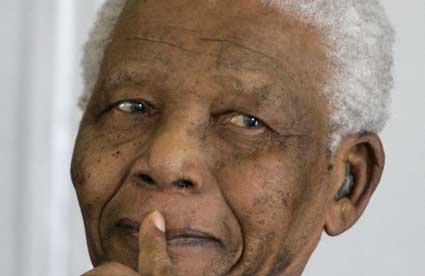
In the December 2008 edition of Harpers magazine, the South African poet in exile Breyten Breytenbach published a 90th-birthday letter to the former President, Nelson Mandela. The letter is replete with despair, grief and anger over the condition of South Africa, and it is full of scenes of misery and violence and reports of official indifference.
Breytenbach then applies the usual South African balm of fantasy: "I expect...that you are immune from sycophancy." "And I don't think your self-deprecating humbleness is fake." "Madiba [Mandela's popular nickname], you will be remembered for being naturally curious and compassionate about the lives of the people you came in contact with." "Dear Madiba, I'm aware of how unfair it is to lay all of the above at your feet, like some birthday bouquet of thorns. You deserve to have your knees warmed by a young virgin, like old King David in the Bible — not pummelled by the likes of me."
As a new South African permanent resident in April of 1994, I stood in line to vote in the first multiracial elections. I was a small-time activist in Cape Town for the next ten years, so I certainly shared Breytenbach's brain fever over the "rainbow nation". The West's fight against racism and authoritarianism was supposed to find its final triumph here.
I dealt with the shock of my disappointment much as Breytenbach did, by nearly going round the bend, although my disappointment went in the opposite direction. It began with facts about Mandela that I learned from his autobiography, Long Walk to Freedom (Little Brown, 1994), and progressed to knowledge of his business dealings when the local investigative magazine noseweek put me on the phone to get dirt.
I found myself interviewing a business manager of Mandela's. This man had told the national and international press that the profits from the sale of lithographs Mandela had signed (but not created, in noseweek's opinion) went to a children's charity. We had proof that the money — probably amounting to many millions of dollars — went into a private family trust of Mandela's, from which he might be making charitable contributions (as anyone might from his own means), although there was no evidence of this that we could find. The manager finally told me that, yes, it was Mandela's money without restriction — he could spend it all on sweets if he wanted.


- They Who Speak for England
- Give Us Poetic Justice
- The Post-American Presidency
- The Tory who Wasn't There
- Banking on Allah
- Only God Can Save Us from Ourselves
- Adventures of a Book in Africa
- Time to Abolish the Arts Council
- Slaves of the Bonus Culture
- Exile on Jermyn Street
- The Unnecessary Recession
- The Long Shadow of Tiananmen
- Silence, Please
- The Golden Age of Conspiracy
- For the Sake of Auld Lang Syne?
- In Vino Veritas: I'll Drink to That
- Towards a New Playing Field
- Nursing Florence Back to Health
- How do we Deal with Tehran?
- Fear and Filth at Brown’s Number 10


4:06 PM
1:06 AM
12:06 PM