



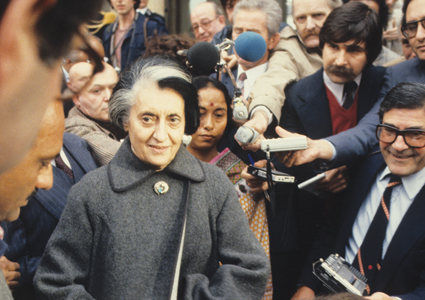
 Indira Gandhi: Presided over unmitigated corruption but also prepared the ground for India’s economic expansion (photo: Jean-Regis Rouston/Roger Viollet/Getty Images)
My own first book was a biography of Indira Gandhi, which I began writing in 1971, inspired by youthful illusions about her anti-poverty slogans. By the time I wrote the last chapter in late 1974, it had become apparent that my subject’s real ambitions were to create an authoritarian, dynastic one-party state. My book predicted that this would result in some form of dictatorship and, with what one reviewer called “the leopard’s timing”, it was launched in the same week as Mrs Gandhi’s proclamation of Emergency in June 1975.
Like the Bourbon royal family in revolutionary France, the Gandhi dynasty in India learned nothing and forgot nothing from the Emergency. A quick return to power was the surest means of avoiding prosecution for the crimes of the Emergency; and Mrs Gandhi achieved this by shrewdly splitting her opponents and bankrolling her loyal supporters. She was only 63 when she stormed back into power in 1980, and her reign might have lasted into the new millennium had it not been cut short by her assassination in 1984.
There were suggestions from my publishers that I might want to update her dramatic story with its tragic climax, but I felt little interest in reporting on what had become a mafia-style family business ruling over a deeply corrupt and faction-ridden political system. Three decades later, an Italian political scientist, Diego Maiorano, has taken on that challenge and produced an analytical study that offers some original insights into an important if dark period in Indian political life.
Maiorano’s thesis is that all the most negative aspects of Indian politics today can be traced back to the early 1980s, when Indira Gandhi presided over a regime of almost unmitigated corruption and dynastic intrigue. Her final term in office was untrammelled by the anti-poverty, socialist slogans of her earlier years and was motivated by a single-minded determination to establish herself and her sons in an unassailable position of power for at least a generation to come. Maiorano’s exhaustively researched account of those years shows how she set out to achieve this by systematically undermining institutions like the civil service, judiciary, parliament and even her own party organisation. The aim was to fill all positions of power with sycophants, and the result was to compromise the integrity and independence of the institutions on which a healthy democracy depends.
Maiorano rightly blames the Gandhi dynasty for the massive increase in illicit election expenditure financed by huge donations of black money to political parties. It was Mrs Gandhi, he points out, who banned legal company donations to political parties back in the 1970s. He also exposes Indira’s growing tendency to play the majoritarian Hindu card during her final term, in contrast to the secular rhetoric of her earlier years. In public, she made frequent visits to various religious shrines, a practice that would have appalled her very secular father, Jawaharlal Nehru. Behind the scenes, she even collaborated with Hindu groups like the RSS to further her electoral ambitions, notably during the Delhi elections of February 1983. In the Punjab, she created her own tragic nemesis by flirting with Sikh religious fundamentalism, culminating in her brutal assassination by her own Sikh security guards.
Like this article? Share, save or print using the icons below:


Post your comment

- Time To Revisit The Two Cultures
- The Battle Against The Philistines Never Ceases
- Anything Dennett Can Do, Scruton Does Meta
- Who Will Do Justice To Our Judiciary?
- Trump's Appeal Is More Roosevelt Than Reagan
- Why France Is Revolting Against The Ancien Regime
- How The EU Elite Paved The Way For Populism
- A Letter To Our Great-Grandchildren