



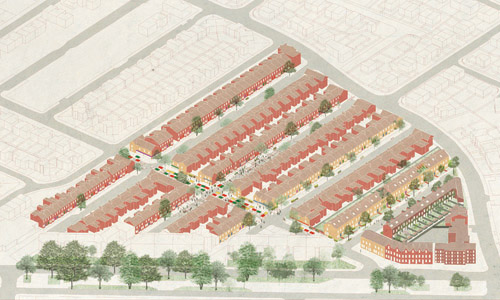
Saved: An axonometric view of the Granby Four Streets project. Toxteth residents had consistently fought government plans for demolition (image: Assemble)
Heseltine’s scheme came at a time of cuts to the national housing budget. The promised investment did not materialise and successive councils operated a principle of “managed decline”. Houses were left to fall derelict through the 1990s. Residents who could move out did, others were relocated to new council flats. There was a tacit arrangement to let the area deteriorate to such an extent that the remaining houses could be bulldozed and the 19th-century brick terraces be replaced with new council homes. As far as the council was concerned, anyone who didn’t want to leave, even residents who had lived in their house for three generations, could go hang.
Erika Rushton, Chair of Granby Four Streets Community Land Trust, explains: “Toxteth was systematically closed down after the riots. Nightclubs were all shut down. Pubs had their licences taken away.” Housing was allowed to fall into ruin; no one on the city council could agree on what should be done with the place. “Granby,” she says, “represents the politics of indecision.”
What the council hadn’t reckoned on was the doughty retirement-age ladies of Granby. While younger families had moved away into new council homes, older residents had refused to budge. In 2012, 140 houses stood empty and derelict and only 60 residents remained. Those who had stuck it out, says Erika, were “sick and tired” of living in streets abandoned by the council.
They decided to take matters into their own hands, beginning by sweeping the streets. Some of the women — and the odd useful man with a stepladder — in the streets east of Princes Avenue began a campaign of “guerrilla gardening”. They planted window boxes and troughs along the fronts of condemned houses and painted cheery domestic scenes on the tin panels nailed to doors and windows: curtains, vases on windowsills, a cat sunning itself. Anything to improve on bricked-up windows and signs saying “DANGER: KEEP OUT”.
When I visited on a glorious sunny morning in June primroses and cornflowers were growing on the scraps of verges around the estate. There were pots of daffodils and the bowl of an old, chipped ceramic loo had been planted with flourishing ferns. Picnic tables with cheerful oil-cloth covering were set up in the pavements. Every Christmas for the last four years, lunch has been served on long tables and chairs the length of one street, with the residents wearing jumpers and hoodies to keep out the cold.
Fluorescent plastic pigeons nest on lamp-posts and crumbling chimneys. Joe Farrag, an industrious man-with-a-ladder, found them their perches. The residents started a Saturday street market with food stalls, crafts, clowns, face-painting, donkey rides, poetry readings and fairy cakes. “We wanted to say: ‘We’re still here’,” says Theresa MacDermott. “It was a way of cheering ourselves up.” More than that, they were restoring streets the council had not thought worth saving.
In 2008, Saving Britain’s Heritage, a campaign group, introduced the Granby CLT to Steinbeck Studios, a social enterprise investor. It was Steinbeck who approached Assemble to turn a run of ten derelict Granby houses into affordable family homes. Assemble’s previous projects had been unconventional: a brick folly under a motorway flyover in Hackney Wick, a barn-like studio faced with concrete tiles in Stratford, both in east London; a petrol station converted into a cinema in Clerkenwell, central London.
At Granby, the priority so far has been housing. Now the CLT is set on attracting businesses to the abandoned units on the four corners of the old Granby market. Joe Farrag talks of canopies and benches, street food stalls and a pavement café.
Erika Rushton, Chair of Granby Four Streets Community Land Trust, explains: “Toxteth was systematically closed down after the riots. Nightclubs were all shut down. Pubs had their licences taken away.” Housing was allowed to fall into ruin; no one on the city council could agree on what should be done with the place. “Granby,” she says, “represents the politics of indecision.”
What the council hadn’t reckoned on was the doughty retirement-age ladies of Granby. While younger families had moved away into new council homes, older residents had refused to budge. In 2012, 140 houses stood empty and derelict and only 60 residents remained. Those who had stuck it out, says Erika, were “sick and tired” of living in streets abandoned by the council.
They decided to take matters into their own hands, beginning by sweeping the streets. Some of the women — and the odd useful man with a stepladder — in the streets east of Princes Avenue began a campaign of “guerrilla gardening”. They planted window boxes and troughs along the fronts of condemned houses and painted cheery domestic scenes on the tin panels nailed to doors and windows: curtains, vases on windowsills, a cat sunning itself. Anything to improve on bricked-up windows and signs saying “DANGER: KEEP OUT”.
When I visited on a glorious sunny morning in June primroses and cornflowers were growing on the scraps of verges around the estate. There were pots of daffodils and the bowl of an old, chipped ceramic loo had been planted with flourishing ferns. Picnic tables with cheerful oil-cloth covering were set up in the pavements. Every Christmas for the last four years, lunch has been served on long tables and chairs the length of one street, with the residents wearing jumpers and hoodies to keep out the cold.
Fluorescent plastic pigeons nest on lamp-posts and crumbling chimneys. Joe Farrag, an industrious man-with-a-ladder, found them their perches. The residents started a Saturday street market with food stalls, crafts, clowns, face-painting, donkey rides, poetry readings and fairy cakes. “We wanted to say: ‘We’re still here’,” says Theresa MacDermott. “It was a way of cheering ourselves up.” More than that, they were restoring streets the council had not thought worth saving.
In 2008, Saving Britain’s Heritage, a campaign group, introduced the Granby CLT to Steinbeck Studios, a social enterprise investor. It was Steinbeck who approached Assemble to turn a run of ten derelict Granby houses into affordable family homes. Assemble’s previous projects had been unconventional: a brick folly under a motorway flyover in Hackney Wick, a barn-like studio faced with concrete tiles in Stratford, both in east London; a petrol station converted into a cinema in Clerkenwell, central London.
At Granby, the priority so far has been housing. Now the CLT is set on attracting businesses to the abandoned units on the four corners of the old Granby market. Joe Farrag talks of canopies and benches, street food stalls and a pavement café.
Like this article? Share, save or print using the icons below:


Post your comment
More Drawing Board
- Ben Uri At 100
- Godfrey MacDomnic
- Ushaw College
- Peter Schmersal
- Mark Boxer
- Carol Robertson
- Drawing Board: Sarah Butterfield
- Drawing Board: Egon Schiele
- Drawing Board: New York Mid-Century
- The Schorr Collection
- The Lod Mosaic
- Disparaged masters of the late Renaissance
- The Arrival of Spring
- Henry Tonks: A Strange New Art
- A Roman Pilgrimage
- Back to the Drawing Board with Andrew Marr
- Giovanni Benedetto Castiglione
- Honoré Daumier
- Sir Hugh Casson
- Laureate of the Trenches
Popular Standpoint topics
