


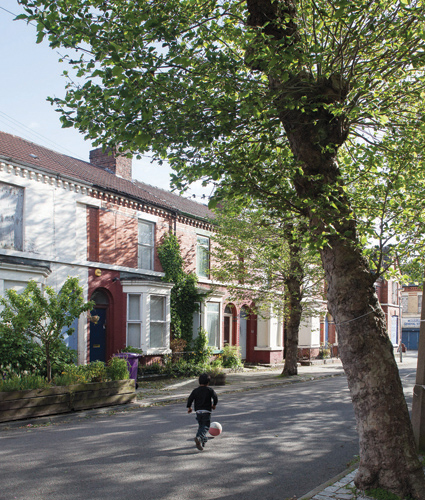
The Granby Four Streets today, reclaimed and replanted by Toxteth residents (photo: Assemble)
Toxteth followed riots in Brixton three months before and ignited copycat protests that same weekend in Wood Green and Southall in London, and Manchester’s Moss Side. A Gerald Scarfe cartoon in the Sunday Times had a pterodactyl-beaked Margaret Thatcher peering through the Downing Street curtains at balaclava louts smashing windows and lighting fires, and wondering aloud: “That’s funny. Are we expecting anyone?” A graph behind her shows unemployment skittering off the chart.
What happened in Toxteth was blamed on unemployment and strained relations between the police and the black community. In 1981, 22 per cent of the economically active population of Liverpool was unemployed. In Toxteth it was 37 per cent — and 47 per cent among young, black men. Across Merseyside, there were 500 unemployed for each unskilled vacancy. Meanwhile, among Liverpool’s 5,000-strong police force, there were only four black officers.
In the week after the riots, one black man in his thirties, unemployed and married with three children, told a Times reporter:
I feel good after the riots. Living with the police here is like having phlegm on your chest. You have to cough it out. When you’ve done that you can sleep sound at night.
Our fight is with the Merseyside police, they are a bunch of racists.
If you have a car in this town it must be stolen. If you have a white girl she must be a prostitute. If you are coming from a club you must be carrying drugs.
My aim was to kill a policeman. We wanted to leave a few of them in the middle of the road with their arms and legs broken. We warned them weeks ago that this town was about to go up.
In the days and weeks that followed there was soul-searching and committee-forming and action-planning. In Toxteth, four churches offered an amnesty to anyone who brought back goods looted during the riots. All that was returned was a bag of sweets.
Sir Geoffrey Howe, then Chancellor of the Exchequer, said more cash was not necessarily the answer. The Prime Minister visited, as did Home Secretary Willie Whitelaw, who did not endear himself to Toxteth residents when he refused to leave his ministerial car.
Michael Heseltine was appointed de facto “Minister for Merseyside”, charged with spending a fortnight in the city and coming up with a “rescue plan”. His car was pelted with eggs and rotting vegetables when he visited an environmental improvement scheme in Princes Avenue. Roy Hattersley, the Shadow Home Secretary, called the enterprise farcical, “throwing ministers at the city instead of money”.
Like this article? Share, save or print using the icons below:


Post your comment
More Drawing Board
- Ben Uri At 100
- Godfrey MacDomnic
- Ushaw College
- Peter Schmersal
- Mark Boxer
- Carol Robertson
- Drawing Board: Sarah Butterfield
- Drawing Board: Egon Schiele
- Drawing Board: New York Mid-Century
- The Schorr Collection
- The Lod Mosaic
- Disparaged masters of the late Renaissance
- The Arrival of Spring
- Henry Tonks: A Strange New Art
- A Roman Pilgrimage
- Back to the Drawing Board with Andrew Marr
- Giovanni Benedetto Castiglione
- Honoré Daumier
- Sir Hugh Casson
- Laureate of the Trenches
Popular Standpoint topics
