



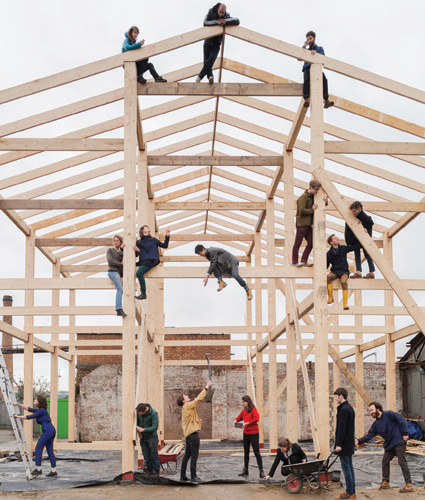
The architectural collective Assemble, pictured during the construction of their “Yardhouse” project in East London (photo: Assemble)
Theresa MacDermott says that taxi drivers used to refuse to drive to Toxteth. They’d say: “No one lives in Granby.” Now they drop passengers outside the Baby Dolls Beauty Salon, opened by Delucia Emina, a Granby local, in a formerly shuttered unit. A black cab arrives with a bottle-tanned, bottle-blonde in the back. She pays and trots into the salon on very high heels.
“Liverpool girls are very glam,” Erika tells me with a reproachful look at my plimsolls. Then, brightening: “You can get your Scouse brows done here!”
What does Granby make of the Turner nomination? Theresa MacDermott heard the news while she was on holiday. A producer from Radio Merseyside called asking for her reaction. “Bloody hell,” was her first response, then: “So what category are we under?” She thought there must be a special category for “community stuff.” She couldn’t believe that an art establishment which celebrated “stacks of bricks, a fish in a tank, and a bed” could be interested in Granby.
Assemble may be the name on the Turner Prize ticket, but the architects are quick to say they arrived late on the scene and that the residents had been battling for years without the Turner taking a jot of notice. Lewis Jones, a founding member of Assemble says: “We are totally inspired by what they have done. After campaigning for so long they got their hands dirty and started sweeping the streets and planting gardens.” The Turner nomination is “a real transformative moment”.
The relationship between residents and the 18-strong architecture collective from London, most of them Cambridge graduates in their twenties, is cheerful and warm. One of the houses has been turned into a base camp with floor plans pinned either side of the fireplace and mugs of tea piled in the sink. Someone from Assemble is on site most days. “We didn’t want a war room in London with blokes pulling tanks around,” explains Erika Rushton. “We wanted the troops on the ground involved.”
There has been no trouble, no hostility: “Not even a bag of nails stolen,” says Rushton. One of the project managers, living in the site office, has her legs waxed at Baby Dolls.
When the four nominations for the Turner Prize were announced in May, one headline summarised the shortlist as: “Three women — and a housing estate.” The contenders are Bonnie Camplin, an installation artist “exploring what ‘consensus reality’ is and how it is formed, drawing from physics, philosophy, psychology, witchcraft, quantum theory and warfare”; Janice Kerbel, an audio and performance artist who “borrows from conventional modes of narrative in order to create elaborate imagined forms”; and Nicole Wermers, also an installation artist, whose works “explore the appropriation of art and design within consumer culture”. Reading such guff, how can anyone not hope Granby’s primroses and neon pink pigeons will triumph?
Granby fought to save its brick terraces when the rest of Liverpool would have seen them crumble. Granby has defied ministers, councillors and regeneration schemes which came to nothing.
Remember Heseltine’s International Horticultural Centre? The day the Centre was announced in 1982, one detractor said with dry understatement: “I don’t think the people of Granby are too strong on gardening.” How wrong he was.
Like this article? Share, save or print using the icons below:


Post your comment
More Drawing Board
- Ben Uri At 100
- Godfrey MacDomnic
- Ushaw College
- Peter Schmersal
- Mark Boxer
- Carol Robertson
- Drawing Board: Sarah Butterfield
- Drawing Board: Egon Schiele
- Drawing Board: New York Mid-Century
- The Schorr Collection
- The Lod Mosaic
- Disparaged masters of the late Renaissance
- The Arrival of Spring
- Henry Tonks: A Strange New Art
- A Roman Pilgrimage
- Back to the Drawing Board with Andrew Marr
- Giovanni Benedetto Castiglione
- Honoré Daumier
- Sir Hugh Casson
- Laureate of the Trenches
Popular Standpoint topics
