


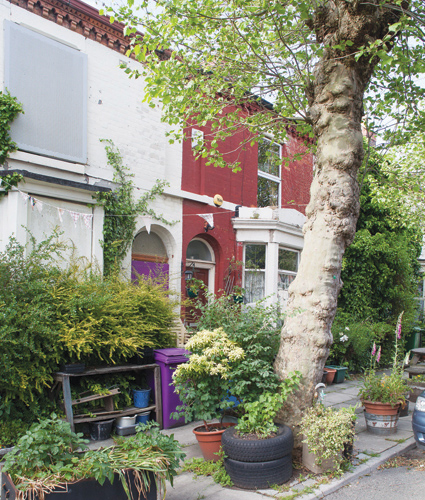
In bloom: Formerly derelict houses on Cairns Street, in Granby, have been renovated (photo: Assemble)
And what did Heseltine come up with? “Let a thousand flowers bloom!” the Minister for Merseyside announced in July 1982, a year after the riots, quoting — to the bafflement of many — Chairman Mao. He called for “entrepreneurial energy” and committed £13 million to a new international horticultural centre to open on the banks of the Mersey in Dingle in 1984. It was hoped the centre would be “the envy of Europe”.
The Festival Gardens, at least, opened by the Queen in 1984, were a success: 3.8 million people visited that summer to admire the pagodas, bridges and 60 ornamental gardens. A local girl in a fetching mermaid costume posed for photographs on a rock above a sailing lake at the grand opening.
In 2012, Heseltine was awarded the Freedom of Liverpool in recognition of his efforts to regenerate the city after the riots, particularly the restoration of the Albert Dock, a 25-year project to clean up the Mersey and handing greater powers to local government.
He had less success, perhaps, when it came to housing. Ray O’Brien, chief executive of Merseyside County Council, scoffed at the time that this regeneration scheme was doomed to be as unsuccessful as all the others: “Show me one brick that has been laid upon another as a result of any of these initiatives.”
For 30 years regeneration schemes had been tried in Toxteth. After the riots, novelist Beryl Bainbridge wrote a sorrowful account of what had happened to her part of town:
Bainbridge described how her daughter, still living in Liverpool 8, couldn’t get anyone out to mend her washing machine. No tradesman would come and no taxis would take a fare to Toxteth.
The Festival Gardens, at least, opened by the Queen in 1984, were a success: 3.8 million people visited that summer to admire the pagodas, bridges and 60 ornamental gardens. A local girl in a fetching mermaid costume posed for photographs on a rock above a sailing lake at the grand opening.
In 2012, Heseltine was awarded the Freedom of Liverpool in recognition of his efforts to regenerate the city after the riots, particularly the restoration of the Albert Dock, a 25-year project to clean up the Mersey and handing greater powers to local government.
He had less success, perhaps, when it came to housing. Ray O’Brien, chief executive of Merseyside County Council, scoffed at the time that this regeneration scheme was doomed to be as unsuccessful as all the others: “Show me one brick that has been laid upon another as a result of any of these initiatives.”
For 30 years regeneration schemes had been tried in Toxteth. After the riots, novelist Beryl Bainbridge wrote a sorrowful account of what had happened to her part of town:
I left Liverpool for London in 1964 and didn’t return for eight years. Liverpool 8 lay beneath a cloud of dust. The authorities were going to bring back the people to the heart of the city. An orgy of organised smashing and erasing and bulldozing was in progress. Then the money ran out.
For nearly 20 years, the rubble and the devastation have multiplied — street after street of mangled houses, lead stripped from the roofs, chimneys toppled into backyards, balconies hanging like bedsteads. Acres of wasteland, dozens and dozens of half-demolished churches and mission halls and factories and warehouses, ton upon ton of bricks and girders and broken glass. Once hidden behind the buildings, and now exposed like rotten teeth, rise the concrete stubs of the ghettos for the local residents, the lower windows of the flats protected by wire grills like the cages at a zoo.
A whole generation has grown up in Liverpool 8, listening to the lullaby sound of houses falling down.
Bainbridge described how her daughter, still living in Liverpool 8, couldn’t get anyone out to mend her washing machine. No tradesman would come and no taxis would take a fare to Toxteth.
Like this article? Share, save or print using the icons below:


Post your comment
More Drawing Board
- Ben Uri At 100
- Godfrey MacDomnic
- Ushaw College
- Peter Schmersal
- Mark Boxer
- Carol Robertson
- Drawing Board: Sarah Butterfield
- Drawing Board: Egon Schiele
- Drawing Board: New York Mid-Century
- The Schorr Collection
- The Lod Mosaic
- Disparaged masters of the late Renaissance
- The Arrival of Spring
- Henry Tonks: A Strange New Art
- A Roman Pilgrimage
- Back to the Drawing Board with Andrew Marr
- Giovanni Benedetto Castiglione
- Honoré Daumier
- Sir Hugh Casson
- Laureate of the Trenches
Popular Standpoint topics
