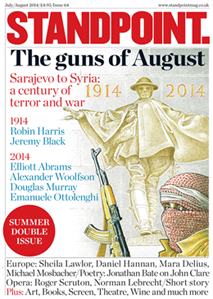



The danger is that events in Ukraine have unpicked the American side of the bargain as well. Burden-sharing is desirable, but collective defence is only guaranteed if the US is prepared to use force. Only 64,000 US military personnel remain in Europe, compared to almost half a million at the height of the Cold War. Even Obama's $1 billion pledge won't substantially change the number of boots on the ground. By contrast, estimates put Russian troop movements during the Crimean incursion alone at about 50,000 men massed on the border, who were able to be rapidly deployed. The incursion was spearheaded by an unexpectedly large number of well-equipped and professional special forces.
Western military leaders have foolishly touted the experience of Afghanistan and Iraq to refocus Western armies on counterinsurgency rather than deterrence. Meanwhile, the response in Russian military doctrine has been to successfully blend a medium-sized conventional force with unconventional tactics to blindside supposedly superior Nato forces. Putin's masterstroke has been to understand Nato's political weakness and the European reluctance to use force at all. Russian doctrine exploits this weakness through speed and unconventional tactics. Even if Nato cannot collectively increase its levels of defence expenditure in the short to medium term, the most important first step would be understanding and responding to this change in Russian doctrine. This would allow Nato rapidly to shut down future threats, both in Europe and elsewhere if China or other powers adopted similar military reforms to leverage inferior militaries.
Russia's Crimean campaign has illustrated that while it lacks the capability to threaten continental war in a Cold War-style confrontation, it is able to shape the proximate environment for its objectives. Nato leaders spoke and acted as if the "red line" for action was the appearance of a Russian armoured column and a stereotypically heavy-handed Soviet invasion force entering Ukraine. Instead, Russia has turned its doctrine on its head. It has used special forces and intelligence operatives, either in civilian clothing or balaclavas and unmarked uniforms lending a semi-plausible deniability. The tactics were based on impressive political-military coordination.
This has allowed political destabilisation, the use of proxy "separatists" and the installation of a client government in Crimea, to render the possibility of Ukraine joining Nato or the EU all but impossible. Russia's 2008 campaign in Georgia not only showed the political possibilities of such lightning strikes but also paved the way for military reform.
The result is the creation of a well-equipped core professional army. Structural reforms have created mobile combat brigades that can move rapidly in under-defended parts of Europe, creating "facts on the ground" before Nato summons the will to respond. The presence of massed Russian forces on the border is not required to invade Ukraine but rather for leverage, to maintain the possibility of escalation in the mind of Nato's political leaders. Russia's other Georgian lesson was that the West will not send in troops if Russian forces are on the ground and at combat readiness. While America's vast military is unable to achieve the country's political ends, Putin has learnt the opposite lesson from his Chechen and Georgian campaigns, where he has achieved his strategic ambitions.
Like this article? Share, save or print using the icons below:


More Features
- The US Can Still Help Save Syria — and Iraq
- On Europe, Nothing Less than Treaty Change will do
- Putin has his Useful Idiots on the Left and the Right
- Sarajevo: Where the Century of Terror Began
- Allen Lane’s Pelicans Take Wing Once More
- How Not to Remember the First World War
- Opera is Not Just Our Most Expensive Noise
- Jonathan Miller: One Man, Two Cultures
- Without a Big Idea, Cameron Will Lose
- A Christian Country? No, a Conservative One
- How to Get School Competition Right
- The War on the Firmest Bulwark of our Liberty
- How Modern Liberals Created Nigel Farage
- Caught in the Trap of His Own Metaphysics
- In Search of My Father, Agent of the Comintern
- Geoffrey Hill and the poetry of ideas
- Master of the Glories of the English Country Garden
- Independence Will Do Nothing for Scots
- Bullying and Bluff on the Road to Referendum
- Maidan is a Reminder of our Forgotten Values
Popular Standpoint topics

3:07 PM
9:07 AM
6:07 AM
1:07 AM
11:07 AM