


This raised a fundamental question: if a state can revive in this manner, did it ever actually fail? The key question with regard to the past 300 years of Poland's history is therefore: why was it not a viable state in 1708 (or indeed in 1988) if it could be a viable one in 2008? The answer was that it was not so much Poland as the international environment and therefore the conditions governing the life of states which had altered, and altered fundamentally.
When I was writing my book in the 1980s, the states deemed successful were those, such as Russia and Prussia, that had shown themselves capable of mobilising their resources into building up a developed and powerful state and playing a significant role on the international scene. Yet, as anyone who has read Christopher Clark's brilliant book Iron Kingdom will agree, the story of Prussia is that of an ambitious dynasty caught in a 300-year-long struggle for survival through dominion that came to grief in 1918, leaving a toxic legacy that would poison the world for much of the 20th century. Russia's history is hardly less unhappy - it is a story of largely pointless expansion unattended by any contingent benefit, which fell apart in the most humiliating manner in 1989. Both ventures inflicted human suffering on an unprecedented scale, on their own people as well as on their neighbours. It is now clear that in the long term those countries, such as Italy and Poland, traditionally dismissed as
basket-cases, have been far more successful than either.
This only really became apparent after 1989. Over the past 300 years, modern Europe's emerging states were caught in a self-perpetuating Darwinian struggle for survival through armed competition and expansion, culminating in the First World War. Although the horrors of that and of the Second World War convinced most Western societies to seek another means of coexistence, Russia remained married to the old model. That meant the rest of the world had to remain on its guard. The end of the Cold War has removed that necessity. And that has changed everything.


- The US Can Still Help Save Syria — and Iraq
- Russian Resurgence has Blindsided Nato
- On Europe, Nothing Less than Treaty Change will do
- Putin has his Useful Idiots on the Left and the Right
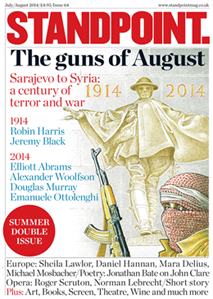
- Sarajevo: Where the Century of Terror Began
- Allen Lane’s Pelicans Take Wing Once More
- How Not to Remember the First World War
- Opera is Not Just Our Most Expensive Noise
- Jonathan Miller: One Man, Two Cultures
- Without a Big Idea, Cameron Will Lose
- A Christian Country? No, a Conservative One
- How to Get School Competition Right
- The War on the Firmest Bulwark of our Liberty
- How Modern Liberals Created Nigel Farage
- Caught in the Trap of His Own Metaphysics
- In Search of My Father, Agent of the Comintern
- Geoffrey Hill and the poetry of ideas
- Master of the Glories of the English Country Garden
- Independence Will Do Nothing for Scots
- Bullying and Bluff on the Road to Referendum

- Conduct Unbecoming: The Classical Commentaries of Norman Lebrecht in Standpoint
- Propaganda Shouldn’t Pay
- The US Can Still Help Save Syria — and Iraq
- A Putrid Pact between Devils
- Strangers in their own Holy Land
- The Taboo of the Tombola
- Putin has his Useful Idiots on the Left and the Right
- Underrated: Tony Abbott
1:10 PM
8:08 PM