


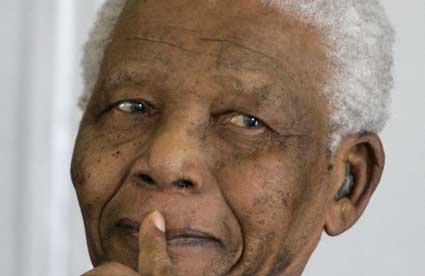
In the December 2008 edition of Harpers magazine, the South African poet in exile Breyten Breytenbach published a 90th-birthday letter to the former President, Nelson Mandela. The letter is replete with despair, grief and anger over the condition of South Africa, and it is full of scenes of misery and violence and reports of official indifference.
Breytenbach then applies the usual South African balm of fantasy: "I expect...that you are immune from sycophancy." "And I don't think your self-deprecating humbleness is fake." "Madiba [Mandela's popular nickname], you will be remembered for being naturally curious and compassionate about the lives of the people you came in contact with." "Dear Madiba, I'm aware of how unfair it is to lay all of the above at your feet, like some birthday bouquet of thorns. You deserve to have your knees warmed by a young virgin, like old King David in the Bible — not pummelled by the likes of me."
As a new South African permanent resident in April of 1994, I stood in line to vote in the first multiracial elections. I was a small-time activist in Cape Town for the next ten years, so I certainly shared Breytenbach's brain fever over the "rainbow nation". The West's fight against racism and authoritarianism was supposed to find its final triumph here.
I dealt with the shock of my disappointment much as Breytenbach did, by nearly going round the bend, although my disappointment went in the opposite direction. It began with facts about Mandela that I learned from his autobiography, Long Walk to Freedom (Little Brown, 1994), and progressed to knowledge of his business dealings when the local investigative magazine noseweek put me on the phone to get dirt.
I found myself interviewing a business manager of Mandela's. This man had told the national and international press that the profits from the sale of lithographs Mandela had signed (but not created, in noseweek's opinion) went to a children's charity. We had proof that the money — probably amounting to many millions of dollars — went into a private family trust of Mandela's, from which he might be making charitable contributions (as anyone might from his own means), although there was no evidence of this that we could find. The manager finally told me that, yes, it was Mandela's money without restriction — he could spend it all on sweets if he wanted.


- Put British Jihadis on Trial in British Courts
- Muslim Women Deserve Better than Sharia Law
- Wanted: New Guardians of the Democratic Process
- Anthony Blunt: Art, Espionage and Treason
- Never Take Religious Liberty for Granted
- The Rise and Fall of the Abstract Art Boom
- Piero della Francesca Found Order Amid Chaos
- In Search of Authenticity
- The Plot to Islamise Birmingham’s Schools
- Nigeria, Iraq, Gaza—The Threat is the Same
- Radical Islam and its Invisible Victims
- The Man Who Tried to Teach us all a Lesson
- Globalisation and The Crisis of the Nation State
- The Medium Isn’t Always the Message
- What sort of Europe does Cameron Want?
- Is China outstripping the West at innovation?
- Piketty’s panacea will make inequality worse
- The Moral Strength of Leonard Cohen
- Designer who taught us to keep it simple
- The US Can Still Help Save Syria — and Iraq

4:06 PM
1:06 AM
12:06 PM