


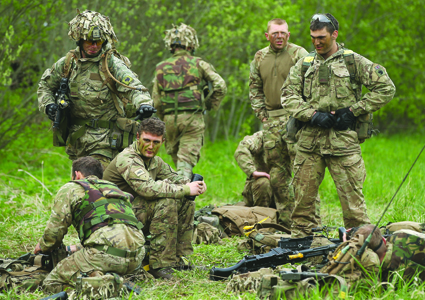
 Combat-ready? British soldiers on a Nato military exercise in Estonia intended to deter Russian aggression (credit: Getty)
This summer looks set to be remembered as a low point in the vitality of global democracy: the shape of global politics has seen unprecedented change in six short months. It is hard to think of a time in the postwar world when the global footprint of freedom has been so comprehensively under threat and in so many different locations. The response by both America and Europe has been ostrich-like. A violent but probably ultimately suicidal Sunni insurgency in Iraq and the ongoing fighting in Syria are likely to give way to an unimaginably powerful Iran, whose fortunes have turned on President Obama's strategic incompetence and push towards American isolationism. A resurgent Iran has wasted no time expanding its sphere of influence. Obama's hasty withdrawal from Iraq and failure to provide the promised "diplomatic surge" have contributed to the violence of the sectarian fracture of the state. The irony of America helping Iran achieve her strategic objectives, while compromising the nuclear non-proliferation stance of the West, is astonishing and would have been inconceivable a year ago. In Asia, the cauldron of disputes is reaching new levels of tension between China, Vietnam, the Philippines and Japan. At the same time China is clamping down on the limited freedoms of Hong Kong. The British press has seemingly forgotten about the crisis in Ukraine while Russia has cut off gas supplies to her neighbour and some Russian companies are in the process of switching contracts to the Chinese renminbi, reducing Western sanctions to an annoyance.
Nato needs to take several important lessons from this mess. First, that despite the rhetoric, Obama is the least globally involved American president since the Second World War. The contours of American military response to global crises appear to be limited to fig-leaf troop deployments measured in the hundreds of men, and limited air strikes. Obama's foreign policy maxim "Don't do stupid shit" can be translated, in policy terms, as an effective move to isolationism. A seasoned strategist might suggest that the avoidance of "stupid shit" is not a policy but a state of mind that translates to inaction. Not doing anything has left America with only a selection of very bad geopolitical choices. America's defence of democracy may well be sacrificed in favour of a return to the 19th-century notion of effectively creating buffer states between great powers. Ukraine would be one such example and Iraq might ultimately be balkanised in a similar way between the respective Shia and Sunni powers, Iran and Saudi Arabia. Second, the building of relations between Russia, China, Syria, Iran and perhaps by proxy Iraq, is significant. The alliance of oil and gas producers and the huge Chinese market underscores Western economic as well as political miscalculation. The spread of democracy, which America and Western Europe have taken for granted, is under assault by countries who have now demonstrated that they are able to exploit the unwillingness of Nato to engage strategically.
As America remembered over Memorial Day weekend the human cost of its commitment to defending democracy, Europe awoke to a new political reality in the form of resurgent extremist and nationalist politics. For those still downplaying the significance of Russia's Ukrainian incursion, there was little respite. The European elections occurred simultaneously with the Ukrainian elections, in a week in which Vladimir Putin signed the Eurasian Union into existence, and an unapologetic President Obama restated his incoherent retrenchment of US foreign policy at West Point.
Putin's appearance on the beaches of Normandy for the D-Day commemoration was symbolic of the degree to which European and American responses to Russia's occupation of Crimea have had little effect. Attempts to isolate Russia economically have been put into perspective by the strategic Sino-Russian gas deal, which some estimates value at $400 billion over 30 years. The deal was accompanied by joint military manoeuvres and a declaration of concern about Ukraine, seemingly absolving Putin of Chinese condemnation and paving the way for future cooperation. Obama's strategic miscalculations in Europe and Asia have made concrete a Eurasian partnership that seemed improbable at the start of the year and is intended to counterbalance American power. Equally, the Russian stock market and rouble have both rebounded since the lows at the start of Western sanctions. Nonetheless, there is still violence in the east of Ukraine, despite an apparent reduction in the Russian troop build-up on the border.
Like this article? Share, save or print using the icons below:


More Features
- Mr Cameron, Show The Country That You Care
- Campaign Diary
- Defying Duopoly: The Rise Of The Insurgents
- Don't Rig The System In Favour Of Coalitions
- Warring Gangsters Who Run The Country
- Political Correctness Is Devouring Itself
- An Archival Treasure Trove—And All Online
- Do we value freedom of speech in Britain?
- Can Europe's Jews Feel Safe Alongside Muslims?
- We Cannot Avoid The Battle Over Blasphemy
- Inside The World Of 'Non-Violent' Islamism
- We Can Fix The Economy But Not Human Nature
- The Keynesian Versus The Monetarist: A Lost Decade
- The Keynesian Versus The Monetarist: Time To Re-Read Keynes
- The New Language Of Political Narcissism
- Two Words You Won't Hear This Election: Foreign Policy
- The Many Faces Of Holocaust Denial
- Why Is 'Fifty Shades of Grey' the New Normal?
- Obama scuttles. America retreats. Things fall apart
- Putin and the Art of Political Fantasy
Popular Standpoint topics

- The Loss Of Faith Made Music Mute
- The Great Betrayal: How Liberals Appease Islam
- Political Correctness Is Devouring Itself
- The New Language Of Political Narcissism
- Why The World Still Loves Shakespeare
- Don’t Listen to Britain’s Designer Demagogues
- Who's in Charge of BBC News?
- An English parliament: the only way to save the UK
- The Loss Of Faith Made Music Mute
- The Great Betrayal: How Liberals Appease Islam
- Political Correctness Is Devouring Itself
- The New Language Of Political Narcissism
- Why The World Still Loves Shakespeare
- Don’t Listen to Britain’s Designer Demagogues
- Who's in Charge of BBC News?
- An English parliament: the only way to save the UK
- The Loss Of Faith Made Music Mute
- The Great Betrayal: How Liberals Appease Islam
- Why The World Still Loves Shakespeare
- Who Will Lead The Berlin Band?
- Putin and the Art of Political Fantasy
- Political Correctness Is Devouring Itself
- The New Language Of Political Narcissism
- Inside The World Of 'Non-Violent' Islamism
3:07 PM
9:07 AM
6:07 AM
1:07 AM
11:07 AM