


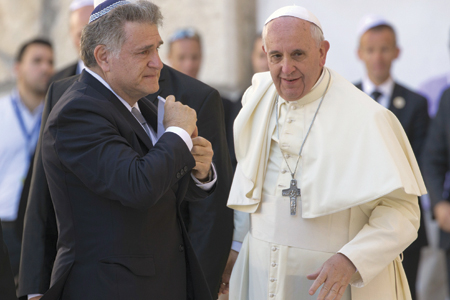
Pope Francis with Rabbi Abraham Skorka: Each of the last three popes has had Jewish interlocutors and friends among the rabbinate (photo: Andrew Medichini/AFP/Getty)
Perhaps the overriding intellectual imperative of a globalised world, in which no culture can hope to isolate itself or to avoid the encounter with others, is to make it possible for those holding different and potentially antagonistic beliefs to live in peace with one another. This is a particular duty for those whose vocation it is to teach with authority, whether sacerdotal or academic; yet it is a duty that is almost always shirked. For priests and professors alike are at home with the formulation of doctrine, the exegesis of texts and the preservation of tradition. They are temperamentally unsuited to the confrontation between theory and practice. Taking responsibility not only for what is taught but for what follows from the teaching, for what is done in the name of religion or ideology, seems to pose an almost insuperable challenge for the guardians of doctrine.
Yet doctrine, "teaching" or "that which is taught", implies, like the cognate term "doctor", worldly as well as spiritual authority. When the University of Oxford awards degrees, the Vice-Chancellor and his Proctors address the new graduate as Domine or Magister ("lord" or "master"). Popes are symbolised by (and until St John XXIII regularly wore) a triple crown, indicating their teaching authority, their Magisterium, over secular rulers; "Professor" takes precedence over other titles, even inherited ones; "Rabbi" carries a similar prestige. Those entitled to teach on behalf of a religion wield a unique kind of authority and their influence may be political no less than spiritual.
How then may the arbiters and exponents of doctrine be persuaded to soften their orthodoxy sufficiently to open up a space in which competing claims to truth may be resolved or not, as the case may be, but in any case without bloodshed? The greatest religious thinkers may range freely across an intellectual terrain they have made their own, but lesser minds tend to stick rigidly to rules and to the literal interpretation of scripture. The deadening effects of the latter are the reason why terms such as "doctrinaire" and "dogmatic" have acquired such negative significance. It is sometimes the case that the doctrinaire and the dogmatic elements within a faith community restrict, censor or even excommunicate the freer, more creative spirits. But it is also true that when the doctrines of the free spirit depart too radically from orthodoxy, perhaps in the attempt to achieve ecumenical goals, then the charge of heresy may indeed be justified and a parting of the ways becomes inevitable. The new doctrine either dies with its originator, or becomes the seed of a new religion. The distinctions between Sunni and Shiite, or between Catholic and Protestant, may have grown more entrenched over the centuries, but at their origins were genuine theological disputes. The Inquisition's most notorious case, against Galileo, was not against his discoveries but his adherence to a theory, Copernican heliocentrism, which not even the greatest of contemporary astronomers, Tycho Brahe, had been able to test to his satisfaction. One may deplore the anathematisation of Spinoza by the Amsterdam Jewish community, but his critiques of Biblical and Halachic authority were indubitably heterodox. In all these cases, the forces of change were resisted by the religious establishment on perfectly rational grounds. We must not expect anything to be different today — except that secular establishments are apt to be at least as protective of their ideological purity as religious ones are of doctrinal orthodoxy.
Perhaps the overriding intellectual imperative of a globalised world, in which no culture can hope to isolate itself or to avoid the encounter with others, is to make it possible for those holding different and potentially antagonistic beliefs to live in peace with one another. This is a particular duty for those whose vocation it is to teach with authority, whether sacerdotal or academic; yet it is a duty that is almost always shirked. For priests and professors alike are at home with the formulation of doctrine, the exegesis of texts and the preservation of tradition. They are temperamentally unsuited to the confrontation between theory and practice. Taking responsibility not only for what is taught but for what follows from the teaching, for what is done in the name of religion or ideology, seems to pose an almost insuperable challenge for the guardians of doctrine.
Yet doctrine, "teaching" or "that which is taught", implies, like the cognate term "doctor", worldly as well as spiritual authority. When the University of Oxford awards degrees, the Vice-Chancellor and his Proctors address the new graduate as Domine or Magister ("lord" or "master"). Popes are symbolised by (and until St John XXIII regularly wore) a triple crown, indicating their teaching authority, their Magisterium, over secular rulers; "Professor" takes precedence over other titles, even inherited ones; "Rabbi" carries a similar prestige. Those entitled to teach on behalf of a religion wield a unique kind of authority and their influence may be political no less than spiritual.
How then may the arbiters and exponents of doctrine be persuaded to soften their orthodoxy sufficiently to open up a space in which competing claims to truth may be resolved or not, as the case may be, but in any case without bloodshed? The greatest religious thinkers may range freely across an intellectual terrain they have made their own, but lesser minds tend to stick rigidly to rules and to the literal interpretation of scripture. The deadening effects of the latter are the reason why terms such as "doctrinaire" and "dogmatic" have acquired such negative significance. It is sometimes the case that the doctrinaire and the dogmatic elements within a faith community restrict, censor or even excommunicate the freer, more creative spirits. But it is also true that when the doctrines of the free spirit depart too radically from orthodoxy, perhaps in the attempt to achieve ecumenical goals, then the charge of heresy may indeed be justified and a parting of the ways becomes inevitable. The new doctrine either dies with its originator, or becomes the seed of a new religion. The distinctions between Sunni and Shiite, or between Catholic and Protestant, may have grown more entrenched over the centuries, but at their origins were genuine theological disputes. The Inquisition's most notorious case, against Galileo, was not against his discoveries but his adherence to a theory, Copernican heliocentrism, which not even the greatest of contemporary astronomers, Tycho Brahe, had been able to test to his satisfaction. One may deplore the anathematisation of Spinoza by the Amsterdam Jewish community, but his critiques of Biblical and Halachic authority were indubitably heterodox. In all these cases, the forces of change were resisted by the religious establishment on perfectly rational grounds. We must not expect anything to be different today — except that secular establishments are apt to be at least as protective of their ideological purity as religious ones are of doctrinal orthodoxy.
Like this article? Share, save or print using the icons below:


More Features
- Can Macron Save France — Or Is He Its Undertaker?
- Europe's Revival Is At Hand, Thanks To Brexit
- Is This The Most Important British General Election Since 1979?
- The New Europe Must Be About More Than Money
- Our Best Brexit Policy Is All-Out Free Trade
- The Bursting Of Our 'Kabubble' Fantasies
- Gambling On A Greater More Gracious Britain
- Xi Versus Trump: The Emperor And The Tycoon
- Can Trump Square The Circle On Fiscal Reform?
- Donald Trump And The Dividing Of America
- Theresa May Emerges From Thatcher's Shadow
- Not Tweets And Anger But Redoubled Vigilance
- Why France Is Revolting Against The Ancien Regime
- How The EU Elite Paved The Way For Populism
- Trump's America: The End Of Exceptionalism
- The Kaliningrad Contingency
- Mrs May Is Too Canny To Say Farewell To Arms
- To Understand Trump, Read Huxley — Not Orwell
- A Letter To Our Great-Grandchildren
- Trump Is No Loser, But Government Will Be Harder
Popular Standpoint topics

- Time To Revisit The Two Cultures
- The Battle Against The Philistines Never Ceases
- Who Will Do Justice To Our Judiciary?
- How The EU Elite Paved The Way For Populism
- Trump's Appeal Is More Roosevelt Than Reagan
- Anything Dennett Can Do, Scruton Does Meta
- Why France Is Revolting Against The Ancien Regime
- A Letter To Our Great-Grandchildren
11:12 AM