


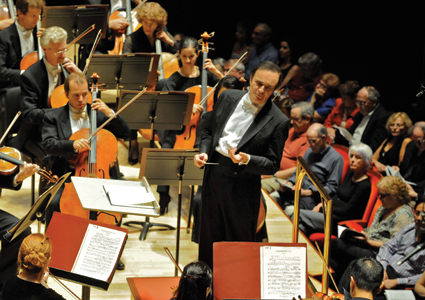
The former fabulous Philadelphians: The city's symphony orchestra has run out of funding (Pete Checchia)
Like a condemned man on a guillotine that jams in mid-fall, the symphony orchestra appears to survive on a whim and a prayer. The past year has been a testing one, the most parlous in memory, and few orchestras go into the summer festival whirl feeling entirely secure about what lies beyond.
Take a look at the 2011 toll so far. An incoming Dutch government pledged eight months ago to abolish all radio orchestras. They are still talking about it and a vote is due in parliament some time soon, but a country that once discussed culture with sombre reverence is now resorting to the rhetoric of Sarah Palin and the Governor of Kansas, who recently eliminated all state funding for the arts. Culture is no longer a sacred cow. Climate change in the political arena has heated up a tide of public resentment towards arts subsidy.
Elsewhere, Spain and Portugal, growth markets for symphonic music, have frozen over with economic fear. The orchestra in Seville has taken a 40 per cent funding cut, par for the course, and has called on the state to stop funding Daniel Barenboim's showcase East-West Divan. It's dog-eat-dog in Iberia.
In South America, the orchestras of the Teatro Colón in Buenos Aires are locked out by their bosses and have not been paid for months. In Rio, the business-backed Brazil ian Symphony Orchestra has sacked half its musicians and is being boycotted as a result by the country's top soloists, Nelson Freire and Cristina Ortiz.
The United States sustains half the world's 500 or so professional orchestras. After decades of conservatism, the floodgates finally broke last winter. Symphony orchestras in Honolulu, Syracuse (NY) and Bellevue (WA) went into liquidation. Detroit toughed out a six-month strike before musicians finally accepted a 22 per cent pay cut; some of the best players have since left town. Louisville went into bankruptcy protection with a view to cutting the orchestra to chamber size; Columbus, Ohio, has halved its band.
And then came the bombshell. In March, Philadelphia, the first US orchestra to earn world fame in the 1920s when Leopold Stokowski conducted and Rachmaninov gave premieres, went into Chapter 11 bankruptcy to fend off its creditors. Philadelphia is — with Boston, Chicago, Cleveland and New York — one of America's big five orchestras, so designated for the power of their playing and the depth of their financial endowment, built over a century. The Philadelphia sound was once held to be the acme of musical perfection, a symbol of what musicians could achieve in a free society. The conductor Klaus Tennstedt wept at his first rehearsal, telling the musicians how he and his father would crawl under the bedclothes in Nazi Germany to hear their contraband message. Philadelphia was the pride of American orchestras.


- Theresa May Emerges From Thatcher's Shadow
- Not Tweets And Anger But Redoubled Vigilance
- Why France Is Revolting Against The Ancien Regime
- How The EU Elite Paved The Way For Populism
- Trump's America: The End Of Exceptionalism
- The Kaliningrad Contingency
- Mrs May Is Too Canny To Say Farewell To Arms
- To Understand Trump, Read Huxley — Not Orwell
- A Letter To Our Great-Grandchildren
- Trump Is No Loser, But Government Will Be Harder
- Trump's Appeal Is More Roosevelt Than Reagan
- The Trump Presidency: A Worst-Case Scenario
- We Cannot Take Liberal Democracy For Granted
- No Need To Fear Russia. The Bear Is Broke
- Who Will Do Justice To Our Judiciary?
- Trust Westminster On Brexit: It's All We've Got
- Back to the "Future Of Socialism", Mr Corbyn?
- Would The Little Lady Like A Wee Dram?
- The Coalition We Need To Defeat Islamism
- Are We Losing The War On Home-Grown Terror?

10:07 PM
7:07 PM
4:07 PM
1:07 PM
10:07 AM
1:07 AM
11:06 PM
11:06 PM
10:06 PM
7:06 PM