


"There is no hope without fear," wrote Spinoza in his Ethics, "and no fear without hope." Today, the West is haunted by fear. It was Spinoza, together with Locke, who won the battle for religious toleration as the foundation of a political settlement that made possible the Anglophone Enlightenment. That battle for toleration needs to be won again today, on both sides of the Atlantic, because we live again in an age of intolerance: not only the intolerance of radical Islam, but also the intolerance of a radical secularism that takes its cue from Voltaire's motto: "Ecrasez l'infâme!"
Today, we also need thinkers who can make the case for toleration in a wider sphere: thinkers capable of defending the market economy against its detractors, of defending the rule of law against anarchy, of upholding the liberties and values of the West against its enemies, internal and external.
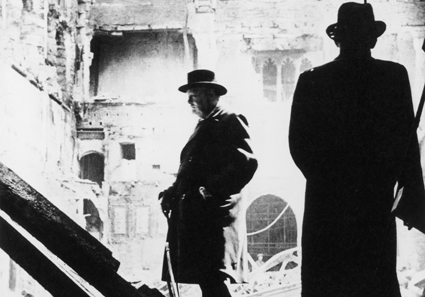
Never surrender: Churchill at the House of Commons after a bombing raid in 1940
This year, we have been celebrating the 70th anniversary of that darkest yet also most heroic episode in our history when Britain stood alone against the menace of Nazi Germany. Churchill rallied a nation still reeling after the evacuation of its army from the Continent of Europe at Dunkirk and the ignominious defeat of its main ally, France. On June 4, 1940, with the "miracle" of Dunkirk still fresh in the public mind, he made the first of a series of speeches that together constituted an even greater miracle. Here, as in most of Churchill's orations, the most famous passage comes in the per-oration:
Even though large tracts of Europe and many old and famous States have fallen or may fall into the grip of the Gestapo and all the odious apparatus of Nazi rule, we shall not flag or fail. We shall go on to the end, we shall fight in France, we shall fight on the seas and oceans, we shall fight with growing confidence and growing strength in the air, we shall defend our Island, whatever the cost may be, we shall fight on the beaches, we shall fight on the landing grounds, we shall fight in the fields and in the streets, we shall fight in the hills; we shall never surrender, and even if, which I do not for a moment believe, this Island or a large part of it were subjugated and starving, then our Empire beyond the seas, armed and guarded by the British Fleet, would carry on the struggle, until, in God's good time, the New World, with all its power and might, steps forth to the rescue and the liberation of the old.
Many of the themes that Churchill made his own are already clear in this: the indomitable defiance; the readiness to contemplate the occupation not only of the entire Continent but even of Britain too; the faith in ultimate victory; and the unwavering solidarity with America. I want to focus, though, on the speech that Churchill made on June 18, 1940, in the House of Commons, which he broadcast later that day. It was in this speech that he gave the Battle of Britain its name even before the Luftwaffe's onslaught had begun in earnest. Although this is perhaps the greatest of Churchill's many great speeches, many do not know it. The original manuscript, with his many amendments in blue pencil and set out on the page like Shakespearean blank verse, has recently been put on display. Here is his peroration:
What General Weygand has called the Battle of France is over. The Battle of Britain is about to begin. Upon this battle depends the survival of Christian civilisation. Upon it depends our own British life, and the long continuity of our institutions and our Empire. The whole fury and might of the enemy must very soon be turned on us. Hitler knows that he will have to break us in this island or lose the war. If we can stand up to him, all Europe may be freed and the life of the world may move forward into broad, sunlit uplands. But if we fail, then the whole world, including the United States, including all that we have known and cared for, will sink into the abyss of a new Dark Age made more sinister, and perhaps more protracted, by the lights of perverted science. Let us therefore brace ourselves to our duty and so bear ourselves that, if the British Empire and its Commonwealth last for a thousand years, men will still say: ‘This was their finest hour.'


- Can Macron Save France — Or Is He Its Undertaker?
- Europe's Revival Is At Hand, Thanks To Brexit
- Is This The Most Important British General Election Since 1979?
- The New Europe Must Be About More Than Money
- Our Best Brexit Policy Is All-Out Free Trade
- The Bursting Of Our 'Kabubble' Fantasies
- Gambling On A Greater More Gracious Britain
- Xi Versus Trump: The Emperor And The Tycoon
- Can Trump Square The Circle On Fiscal Reform?
- Donald Trump And The Dividing Of America
- Theresa May Emerges From Thatcher's Shadow
- Not Tweets And Anger But Redoubled Vigilance
- Why France Is Revolting Against The Ancien Regime
- How The EU Elite Paved The Way For Populism
- Trump's America: The End Of Exceptionalism
- The Kaliningrad Contingency
- Mrs May Is Too Canny To Say Farewell To Arms
- To Understand Trump, Read Huxley — Not Orwell
- A Letter To Our Great-Grandchildren
- Trump Is No Loser, But Government Will Be Harder

- Time To Revisit The Two Cultures
- The Battle Against The Philistines Never Ceases
- Who Will Do Justice To Our Judiciary?
- How The EU Elite Paved The Way For Populism
- Trump's Appeal Is More Roosevelt Than Reagan
- Anything Dennett Can Do, Scruton Does Meta
- Why France Is Revolting Against The Ancien Regime
- A Letter To Our Great-Grandchildren
7:12 PM
9:11 AM
2:11 AM
8:10 AM
1:10 AM
5:10 PM
1:10 PM