




BY JULIA PETTENGILL
This week, the Moscow City Court released Yakaterina Samutsevich, one of the convicted members of the anti-Putin punk collective Pussy Riot. Samutsevich was given a suspended sentence on appeal, while the two-year sentences of Nadezhda Tolokonnikova and Maria Alkhina were upheld.
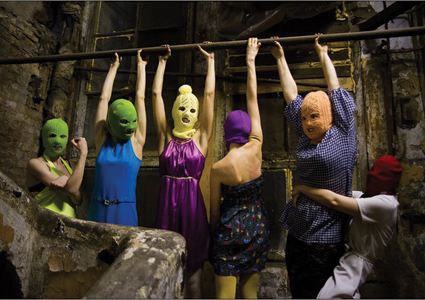
But don't be fooled into thinking that this is a sign of any kind of judicial independence or faithful consideration of the evidence. By all accounts, Samutsevich's release is an example of old-fashioned divide-and-rule tactics by the Kremlin, designed to insinuate that Samutsevich has abandoned her compatriots, discredit the band and divide its members.
Samutsevich, Tolokonnikova and Alkhina were convicted of hooliganism motivated by religious hatred this summer after staging an anti-Putin punk performance in Moscow's Cathedral of Christ the Saviour in February. The court has now released Samutsevich on the grounds that she was detained by a guard upon entering the Cathedral and thus prevented from taking part in the performance.
This fact was already established in the original trial, so to affirm it on repeal suggests that the decision to release Samutsevich was a political one. Mark Feigin, an attorney for the band, alleges that "This decision was taken to show the differentiation of the punishment in case of political defence and in a criminal case," designed to reward Ms Samutsevich's new legal team for emphasising her lack of involvement in the actual performance as opposed to rights to freedom of speech in Russia.
To remind Russians of the cold brutality reserved for dissenters under Putin, Samutsevich's bandmates will be sent to a prison colony to serve out the remainder of their two-year sentences. There's little doubt that the whole episode takes its direction from the Kremlin, a fact reinforced by Vladimir Putin's recent expressions of support for the imprisonment of the three young women, declaring: "It was right that they were arrested, and the court's decision was right," and accusing them of "eroding our moral foundation" and "undermining the country".
Ms Samutsevich's legal team can hardly be blamed for doing what they can to get their client out of jail, and thus far, the blatant use of divide-and-rule tactics doesn't seem to have achieved its aim of discrediting either Samutsevich or the band as a whole. Whether or not Tolokonnikova and Alkhina's attorneys and defenders will be able to keep up the pressure to secure their early release remains to be seen; all that is certain now is that we will soon witness the sad and all-too-familiar sight of young political prisoners headed for a harsh new life in one of Russia's infamous prison colonies.


Post your comment
The Point is Standpoint's staff blog.
- After more than ten years, founder of Standpoint magazine Daniel Johnson stands down as Editor
- Standpoint needs your help — one last time
- Donations to Standpoint will be matched £ for £
- Friends of Standpoint — Donations matched £ for £
- Brexit Revolt – The insider account of the EU referendum
- We need your help and support
- Standpoint Presenting Two Debates At HowTheLightGetsIn 2016
- The Compleat Corbyn — a round-up of Standpoint's Corbyn coverage this month

- Sir Raymond Carr in Standpoint
- Conduct Unbecoming: The Classical Commentaries of Norman Lebrecht in Standpoint
- Chronicling The Crash: A Standpoint Ebook
- Grounds for Hope
- Is Islam a Peaceful Religion? Daniel Johnson at the Oxford Union
- Standpoint's Autumn Salons
- Win Tickets to the Inaugural Standpoint Salon
- Is Hunter's History Bunk?
- Lawson Collects on Climate Change Bet
- The Cabinet meeting that kept Salman Rushdie alive
- Friends of Russia or Friends of Putin?
- Russia's Win-Win Election
- The Kremlin Plays Old Tricks With Pussy Riot
- A Pyrrhic Victory for Georgian Democracy
- Abandoned in Moscow
- Standpoint's New Facebook Page
- No need to pander to the Bear, Mr Obama
- Govemania
- Standpoint Recommends: The Tacitus Lecture 2012

- Is South Africa about to fall apart?
- The inevitability of Fortress Europe
- The devout sceptic: hope for those of little faith
- Corbyn waves the flag of anti-Semitism
- In Corbyn’s mind, there is no place for the Jews
- Is the mental illness epidemic just a myth?
- Viennese rooms with a point of view
- How Monet created motion pictures